31/12/1857 –23/12/1927
Daughter of Mayor of High Wycombe; married a school teacher and lost only son in the Great War
Relatives
Research:
Laura’s Story
Laura Trask, was born Laura Gilbert in the nearby market town of High Wycombe, the daughter of Thomas and Ann Matilda Gilbert. Her father, Thomas, had been born in August 1825 in Princes Risborough, the son of James and Frances Gilbert who ran the George Inn in the High Street. In 1838, when he was aged about 13, Thomas was apprenticed to one Daniel Hearn lace dealer of Chipping (or High) Wycombe. Thomas Gilbert’s family were neither well-off nor well-connected but they were quite enterprising – by 1851 his parents had moved to London and ran a beer shop in Paddington; they then moved in with his sister Frances who ran a cheesemonger’s in St John’s Wood, London, with which Thomas was also involved. His brother William was a miller in Princes Risborough but moved to South Australia after 1861 (aged around 40) where he became a Member of Parliament for 26 years.
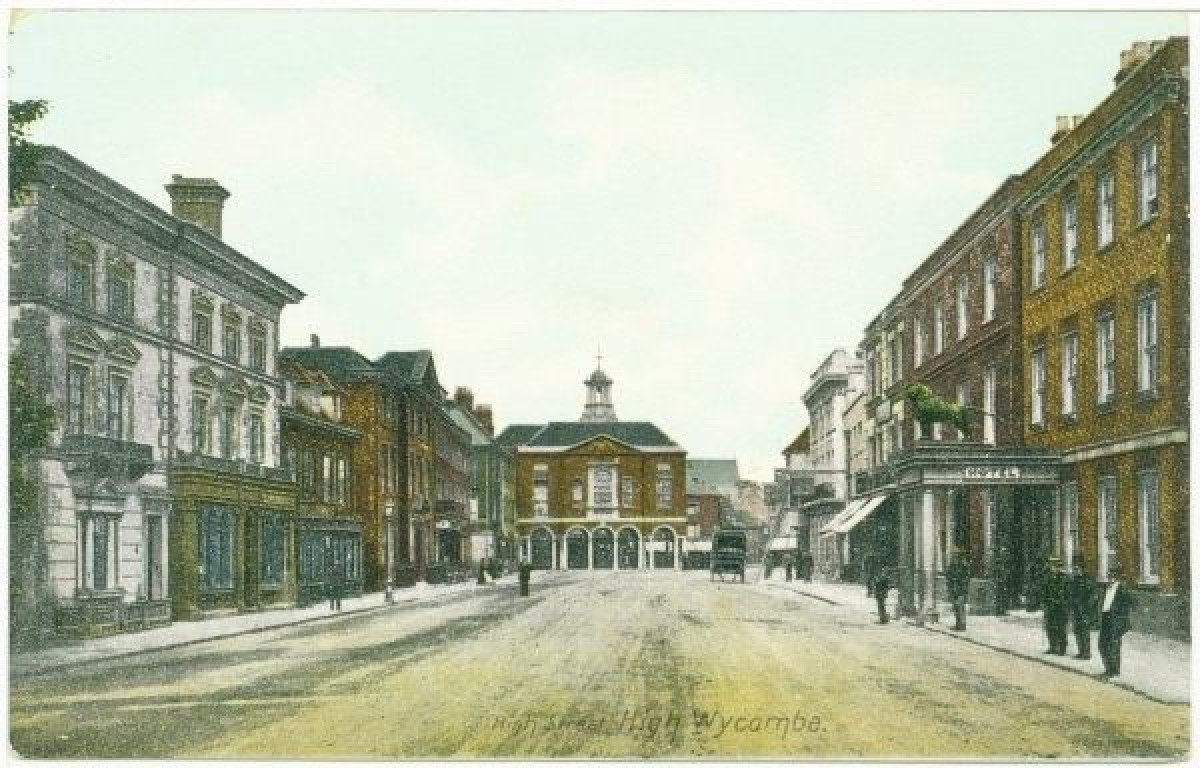
Daniel Hearn died a few weeks after the 1851 census, and left generous bequests to his staff, including £20 and his organ to Thomas Gilbert. Thomas presumably took over the business soon after Daniel’s death. In April 1852, aged 28, at St Vedast’s Church, Foster Lane, in the City of London, Thomas Gilbert married 29-year-old Anne Matilda White of Wycombe – her father was a head collector of taxes, who lived at 4 London Road, Wycombe. Mr White was described as proprietor of a house and land and owner of woodland, so it would have probably been a good marriage for Thomas, who was described as a lace manufacturer of 9 Cheapside. He presumably moved back to Wycombe as in 1853 he appears in local trade directories as:“Gilbert Thomas and Co., grocers, tea dealers, provision merchants, linen and woollen drapers, silk mercers, hosiers, hatters, and lace manufacturers, High St.” (Musson & Craven Directory, 1853)
Laura was one of five daughters that Thomas and Anne had:
1. Emily White (1853-1939) married Robert Webb at High Wycombe Parish Church on 14th October 1873. When widowed she became a beaded lace manufacturer, then agent for bead and fancy trimmings.
2. Anne Matilda (1854–1941) was unmarried, initially a music teacher, then carried on a fancy trimmings business. In 1901 she lived at 4 London Road, her maternal grandparents’ house. She left £811 when she died in 1941.
3. Florence born 1856, married Edward Ernest Philips at St Mary’s Islington on 7th December 1876
4. Laura born 31st December 1857
5. Amy Flora (1861-1948), married Philip Vaile, a wealthy lace manufacturer of 10 Ormonde Terrace, Regent’s Park, London, at the Parish Church in High Wycombe on 29th June 1887.
In 1861 Laura and her family were living in Buckingham House (known locally at that time as “Bobbins Castle”) High Street, High Wycombe. Her father was described as a lace manufacturer, grocer and draper, his live-in staff included three drapers, three grocers and a lace man, and he had a cook, a housemaid and a nursemaid – so he was reasonably prosperous. The lace business continued to be very successful, even exhibiting pillow lace-goods at the International Exhibition in London in 1862.
In that same year Thomas was invited to give evidence to the Children’s Employment Commission. He claimed to be the most important lace manufacturer and buyer in southern Buckinghamshire and the adjoining “strip of Oxfordshire”, employing, indirectly, about 3,000 persons.
“They are not absolutely engaged by me as workpeople, but I sell them the materials, that is patterns, and silk or thread; and there is a mutual understanding, although no obligation, that I should take all lace for which I have sold the patterns, whether there be demand for it or not, and that the lacemakers should bring it to me and not to any other buyer.”
By 1871 the family had moved to Bedford House, London Road (very close to Laura’s grandparents at 4 London Road) where they lived until 1902.
As with other industries such as paper-making, mechanisation eventually completely dominated lace-making. The Education Acts of 1870 and 1880, which together introduced compulsory schooling up to the age of 10, and the Factory Act of 1878, which prohibited work before the age of 10, meant that children no longer had the time to make high quality lace. Thomas diversified into Yak lace, a coarse bobbin lace typically made from wool, which was cheaper and faster to make, and often used on mourning garments, and also into beaded work, but to no avail. In 1876 he was forced to file for Bankruptcy and in 1878 his entire business was liquidated, paying a final dividend of 5 ¾d.
The ‘Dividends’ notice in the Bucks Herald dated Saturday 21 September 1878 reads as follows:
“GILBERT, THOMAS (Liquidation), High Wycombe, Bucks, Cheapside and Clifton-road, St John’s Wood, both London, lace manufacturer, poulterer and cheesemonger. Final div of 5 ¾d., at Mr. J. D. Viney’s, 99, Cheapside, London, accountant.”
In 1881 Laura was still living with her parents and sister, Anne Matilda, at Bedford House. In spite of her father’s bankruptcy, they were still able to employ a general servant. This was also the case in 1891, by which time Laura was 33 years old. One can only imagine that she was resigned to a life of spinsterhood, working in the family business, as would happen with her sister, Anne Matilda. However, that was not to be as The Leighton Buzzard Observer and Linslade Gazette of 14th January 1896 reported:
“Trask-Gilbert. – On the 8th inst., at the Parish Church, High Wycombe, by the Rev E. D. Shaw, vicar, John Trask , of Berkhampstead, eldest son of John Trask, of Winchester, to Laura Trask, fourth daughter of Thomas Gilbert, of High Wycombe.”
Laura Gilbert and John Trask had previously had their banns read at St Peter’s Church, Berkhamsted on 15th, 22nd and 29th December 1895, with Laura being described as a spinster of High Wycombe, and John stated as being a bachelor of the parish of St Peter’s. Laura was eight years older than her husband, a schoolmaster at Berkhamsted School, and must have been full of joy when her son, John Hedley Trask was born on 20th May 1898. She was 41 years old at the time and never had more children.
Two years later in 1900 Laura’s mother, Anne Gilbert died, leaving an estate worth £94. Her father Thomas continued to judge lacework and beadwork in local exhibitions in Wycombe until 1901.
In 1901 Laura and John Trask were living at Hope Villas, Kings Road, Berkhamsted with baby John and one domestic servant. It is hard to find any evidence as to Laura’s hobbies or personality. She went from being a dutiful daughter, to dutiful wife and mother. The census entries for her never state any personal occupation.
In June 1902, the Gilbert family home at 10 London Road was sold at public auction – the South Bucks Standard reports it being sold by Miss Gilbert (despite Thomas still being alive) for £1,500.
Laura’s father, Thomas Gilbert, died in May 1904 of a general decline and he seems not to have left a will. He appears from the glowing local obituaries to have been well respected.
“DEATH OF A NOTABLE MAYOR. By the demise of Mr. Thomas Gilbert, of High Wycombe, the county of Bucks has lost one of its most prominent personages. Mr. Gilbert, who was a member of the Town Council of High Wycombe from 1860 to 1880, was Mayor during an important period in the history of the town. He will be best remembered as one of the leading pioneers in his earlier years of the revival in the well-known Buckinghamshire lace industry and was also the originator of the cognate industry of beadwork, which has ever since found employment for hundreds of poor rural workers in the county.” (Bucks Herald, Friday 13 May 1904)
In 1911 Laura and John were still living at Hope Villas, Kings Road. Their home still stands and was described in the Berkhamsted Conservation Area Character Statement as:
5 & 7 Kings Road (Hope Villas)
An unspoilt pair of villas that sit up on the hillside, set back from Kings Road and with generous gardens
Nos. 5 & 7 Kings Road form a pair of semi-detached villa style houses. Late C19th. Slate roof with gable end brick stacks. Unrendered buff and darker brick with colourwashed red brick dressings to the window openings, carried across the façade as banding at first floor sill level. Painted rendered surrounds to bay windows. Rectangular stone plaque with inscription ‘HOPE VILLAS’. Two storeys. Mirror pair of houses, with principal room each side of adjacent entrance halls. Window openings have slightly cambered arches. Each house has two 2-over-2 paned sashes over gabled bay window with hipped slate roof also with 2- over-2 paned sashes to centre and cants beside shared stone steps up to door with chamfered reveals 3 panelled base, the upper half with 3 glazed panels and narrow rectangular overlight.
On 8th March 1917, at Watford, Laura’s only child, John Hedley, aged 18 years and 10 months was enlisted into the war effort. Laura must have been terrified watching her only child going to war, as the First World War had already taken the lives of two of her nephews, one of whom was Philip Amyas Vaile was born in July 1894 in Marylebone, son of Laura’s sister Amy Flora and her French husband, Phillipe Vaile.
He was one of three sons brought up at 10 Ormonde Terrace, Regents Park. He became a pupil at Brighton College in 1907 and was a member of Chichester House, before joining the Honourable Artillery Company which was then, as now, a territorial regiment staffed mainly by City professionals and based near Liverpool Street in London. As might be expected he did not actually stay in the Honourable Artillery Company when war broke out but, having been commissioned as a 2nd Lieutenant, served in the London Regiment.
However, in 1916 he was posted for a while to the Central School in Le Havre in 1916. The Central School was one of many establishments across Northern France intended to improve the quality of newly arrived troops in situ through contact with serving personnel. A posting to such a school a fair distance behind the lines must have seemed to an officer like Philip Vaile a welcome and relatively safe respite from the hardships and dangers of the trenches. However, while he was training a contingent of Canadian troops Phillip Vaile was killed when a grenade exploded prematurely, a very unfortunate accident in what should have been a relatively safe place to spend the war. The tragedy for his family was compounded by the fact that his elder brother Edward had been killed the previous year while serving with the Worcestershire Regiment.
The Hertford Mercury and Reformer of 8th December 1917 reported as follows:
“BERKHAMSTED
LOCAL SCHOOLMASTER’S LOSS
Second-Lieut. John Hedley Trask, Hampshire Regt., who died on November 20, from wounds received in action, was the only child of Mr and Mrs John Trask, of King’s Road, Berkhamsted, and was aged 19 ½ years of age. He was educated at Berkhamsted School, where his father is a master, and at Chigwell, and was a member of the O.T.C at both schools. He had only been at the Front five weeks when he made the great sacrifice”.
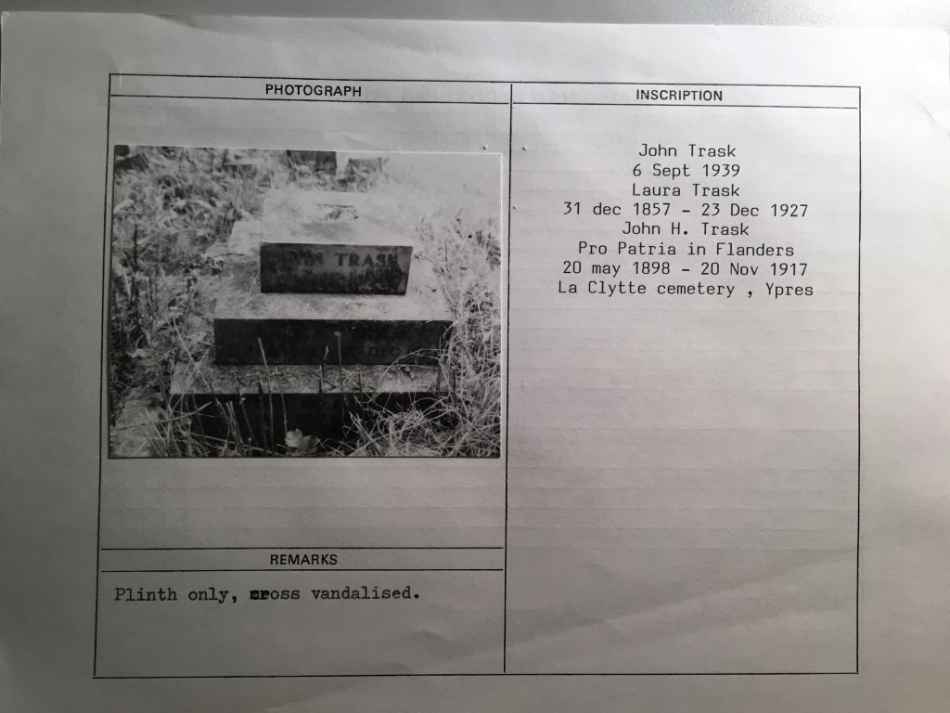
Laura’s grief at the loss of her only child must have been immense. She and her husband remained living at Hope Villas, where she died on 23rd December 1927. Probate was granted to her husband on 7th February 1928, with effects worth £1834 15s.


 View burial


 Personalities of the Past
 The Fallen of WWI in Rectory Lane Cemetery
 Memorial Symbolism
