13/07/1862 –24/07/1913
Emigrated to America, survived sinking of SS Oregon and established construction company in Chicago
Relatives
Research:
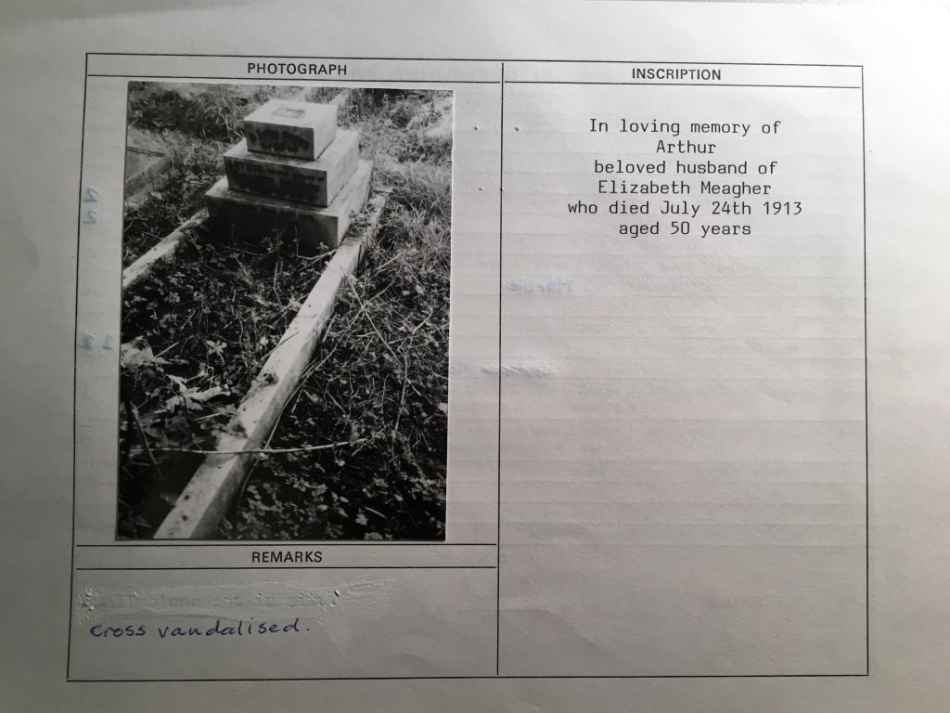
Plot 312: Arthur husband of Elizabeth Meagher died 24 July 1913 aged 50.
The earliest record of Arthur Meagher’s family in the area was when his 2x Great Grandparents John Meager and Sarah Harvey were married at St Albans Abbey on 18th October 1759. The couple appear to have immediately settled in Little Gaddesden, which is where Arthur’s Great Grandfather, John Meager, junior, Grandfather James Meager and father, George Meager, were all born and baptized. Through this time the spelling of family surname was consistently recorded as Meager.
Arthur’s father George Meager married his mother, Elizabeth Fowler, at St Peter’s Church Berkhamsted on 14th October 1854. George and Elizabeth settled in Cox Lane. Beorcham in the Berkhamsted Review of Aug 1946 describes Cox Lane as “the narrow lane which was widened in late Victorian days and renamed King’s-road. In a row of eight cottages there was but one drinking water tap and one rainwater tank. The cottagers also shared a big old-fashioned brick oven, taking turns to cook their dinners.”
George was a labourer in 1861, whilst Elizabeth gave her occupation as being a Bonnet Sewer.
George and Elizabeth had ten children:
1) George William baptized on 23rd May 1858
2) Sarah Ann baptized on 23rd May 1858
3) Frederick Daniel born on 3rd February 1859
4) Emily born on 3rd November 1860
5) Arthur born 13th August 1862
6) Frank born 30th December 1863
7) Harry born 29 August 1866
8) Ernest born 16th April 1869. Frederick, Emily, Arthur, Frank, Harry and Ernest were all baptised together at St Peter’s on 2nd January 1870.
9) Albert baptised 23rd July 1871
10) Nellie May baptised on 13th April 1874.
In 1871 George senior was a labourer on the railway, whilst George junior was a railway clerk. This census saw the family name spelt Meagher for the first time, and the family appear to have adopted this spelling for future use. Arthur’s father, George, passed away in the spring of 1877, living his wife a widow, aged 40. However, Elizabeth was probably able to get financial help from her children. Her eldest daughter, Sarah Ann, was already working in Sunnyside as a Housemaid by the time she was 14 in 1871. The Elizabeth and the younger children remained in Cox Lane/Kings Road
The first of Arthur’s siblings to get married was Frederick, who married Mary Ann Luft from Aylesbury in March 1880. Frederick was working as a bricklayer in 1881, when he and his new wife can be found living in Upper Kitsbury Road. In 1881 Arthur was also working as a bricklayer, though still living at home with his mother and younger siblings. Arthur’s second sister, Emily, had also gone into service, working as a housemaid for Mr Frank Moore, J.P. of Woodcock Hill. On 17th November 1885 Emily married John Bonfield, a butler from Yarmombe in Devon, at St Peter’s Church.
From this time onwards the Meagher family appear with less frequency in records relating to Berkhamsted. The first clue to what was happening to the family can be found in a local newspaper. On 20th March 1886 The Bucks Herald reported the following:
“The Perils of the Deep
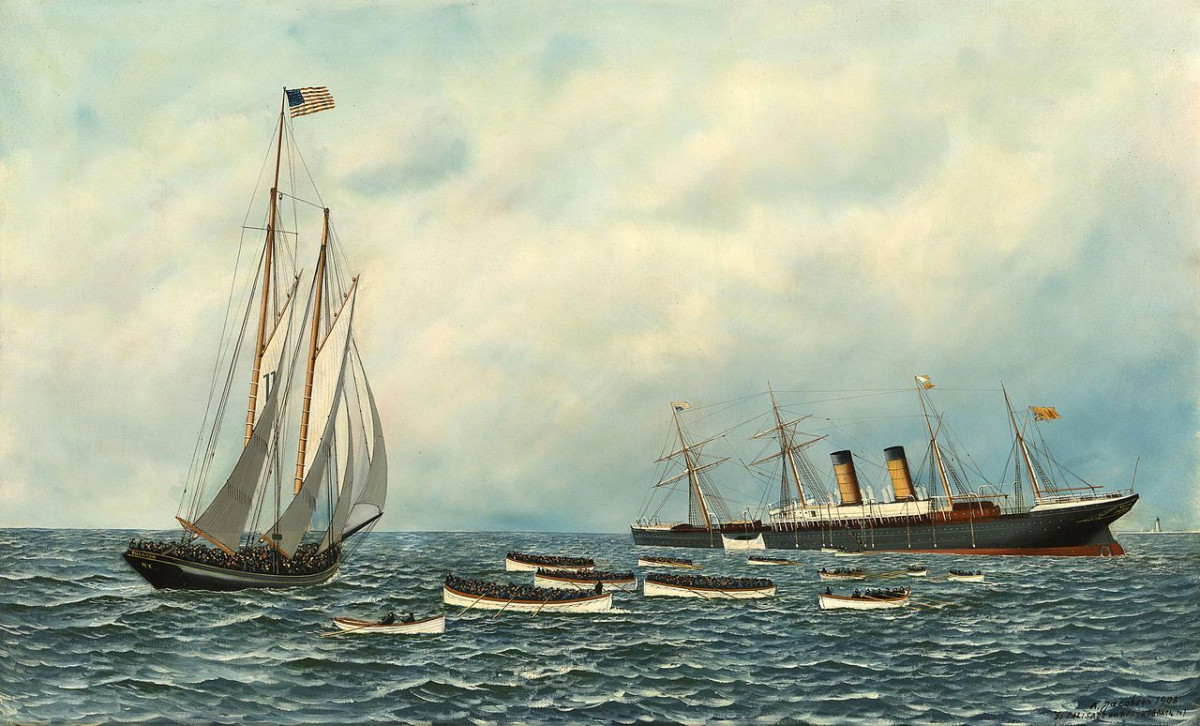
On board the Cunard liner Oregon, which collided off New York on Sunday morning, and sank eight hours afterwards, were two young mechanics belonging to Berkhampstead who, after spending the winter here, were returning to Chicago. Their names are Noah Foskett and Arthur Meager. A Miss Attewell, formerly of Berkhampstead, was also among the passengers, who were all saved”.
The SS Oregon was a record breaking British passenger liner that won the Blue Riband for the Guion Line as the fastest liner on the Atlantic in 1884. She was sold to the Cunard Line after a few voyages and continued to improve her passage times for her new owner. The Oregon sailed from Liverpool on 6th March 1886 with 852 people on board, 647 passengers (186 First Class, 66 Second Class and 395 Steerage) and a crew of 205, along with 1,835 tons of cargo and 598 bags of mail, under the command of Captain Phillip Cottier. At about 4:30am on 14th March, only a few hours from her scheduled arrival in New York City (about 15 miles to the west), she collided with an unidentified schooner, most likely Charles H. Morse, which disappeared in those waters about the same time. The schooner sank almost immediately upon impact with all hands.
Passenger lists reveal that this was not Arthur’s first trip overseas. On 15th May 1882 Arthur arrived in New York, having travelled aboard the “Naesland” from Antwerp, with his brother, Frank. Frank appears to have stayed in the USA because in 1888 there is a record of his naturalisation. Naturalization is the process by which an alien (immigrant) becomes an American citizen. Prior to September 27, 1906, any “court of record” (municipal, county, state, or Federal) could grant United States citizenship. Often petitioners went to the court most geographically convenient for them. In general, naturalisation was a two-step process that took a minimum of five years. After residing in the United States for two years, an alien could file a “declaration of intention” (“first papers”) to become a citizen. After three additional years, the alien could “petition for naturalization” (‘second papers’). After the petition was granted, a certificate of citizenship was issued to the new citizen.
Cook County was created on 15th January 1831 by an act of the Illinois State Legislature as the 54th county established in Illinois. It is named after Daniel Pope Cook, one of the earliest and youngest statesmen in Illinois history who served as a member of Congress and the first Attorney General of the State of Illinois. Within one hundred years the county recorded explosive population growth going from a trading post village with a little over 600 residents to four million citizens, rivalling Paris by the Great Depression. Within Cook County, lies the City of Chicago, sitting on Lake Michigan. The State of Illinois took advantage of its Lake Michigan access and the Chicago Portage, beginning with the construction of the Illinois and Michigan Canal in 1848.
It seems that Cook County, Illinois was an attractive proposition for more than the single men in the Meagher family. In 1883 Arthur’s second eldest brother, Frederick emigrated with his wife Mary Ann and two daughters, Emily and Ethel. The family settled in the town of Lake, where Frederick was a bricklayer. Three years after Frederick and his family arrived in the United States, Arthur’s brother, Ernest, also emigrated, receiving his naturalisation from the Circuit Court of Cook County, on 29th September 1890. Eleven days later, on 10th October 1890 another brother, Harry, received his naturalisation from the same court in Cook County. Sadly their brother, Frank Meagher, single man and carpet fitter, had previously died in Cook County, Illinois, on 23rd April 1888, aged 25.
This movement of her sons to the United States meant that in 1891 Arthur’s mother, Elizabeth, was living in the Kings Road with just two children, Albert and Nellie May. Her daughter, Emily, had left Berkhamsted and was living in Kings Langley parish, near to Rucklers Lane. This situation was not to last long, as Albert, the youngest of the Meagher boys, soon followed his brothers over, travelling from Liverpool to Ellis Island on the RMS Umbria. He received his naturalisation from Cook County’s Circuit Court on 21st October 1902.
The only one of Arthur’s siblings to stay in Berkhamsted was Nellie May Meagher. She married Thomas Richard Slatter at St Peter’s Church in Berkhamsted on 9th June 1892, and this couple provided the widowed Elizabeth with a home in her old age in Castle Street. She died in Berkhamsted in 1910. Nellie May remained in Castle Street, dying there on 2nd June 1941.
The migration of the Meagher family was not yet complete. In 1903 Emily and her husband John Binfield, took their three children to Liverpool and travelled on the RMS Umbria to Ellis Island. The Bonfields appear to have settled in the Manhattan district of New York, rather than join Emily’s brothers in Chicago.
Arthur Meagher married his wife, Elizabeth Gates, was also an English immigrant from Ashley Green, on 3rd December 1888 in Chicago and their son Cecil John was born on 6th February 1894 in Chicago. The family appear to have travelled regularly between the UK and US, to visit Elizabeth’s brother, John Gates, a meat dealer, who lived in Willesden. Cecil John Meager was baptised on 6th September 1896 at St Mary’s Church, Willesden. The family’s return passage to the United States is recorded in the passenger lists of the time, when they left Southampton aboard the Saint Paul, bound for Ellis Island.
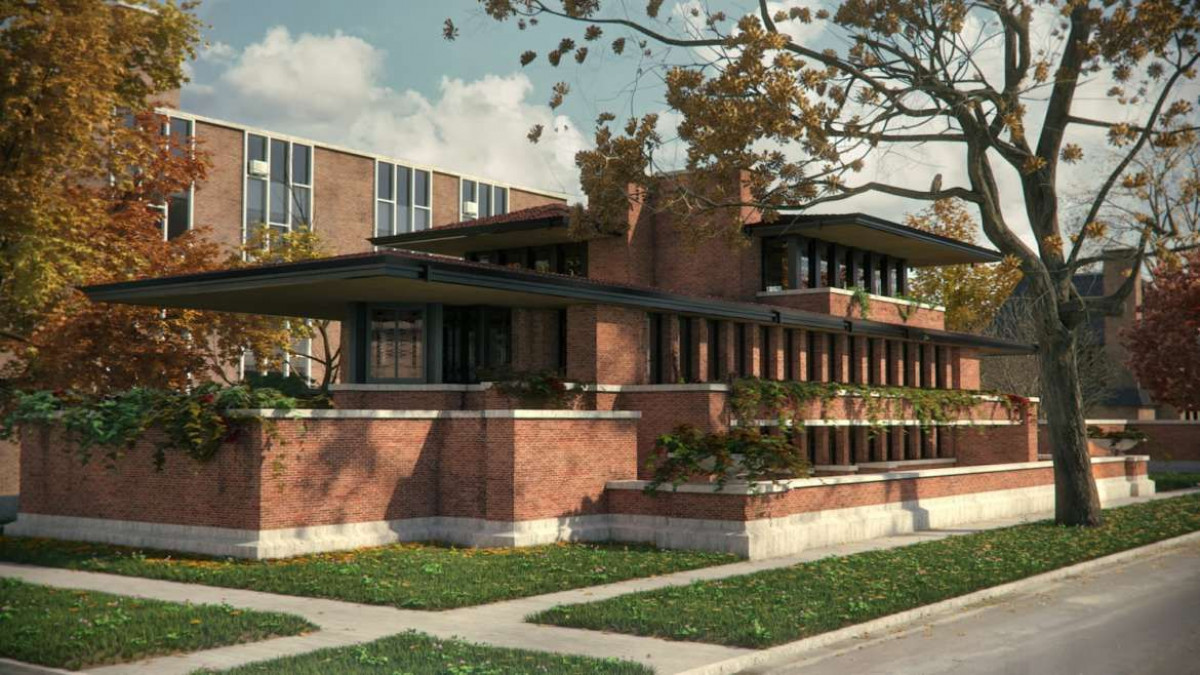
Arthur was a bricklayer by trade. He built many apartment buildings in the Hyde Park neighbourhood of Chicago as well as the Chatham neighbourhood in Chicago. Arthur had his own construction company and was the contractor for several large projects. Perhaps the most noted building Arthur was the contractor for was Robie House at 5757 Woodlawn Ave, Chicago. Frank Lloyd Wright, a famous architect in the US in the early 1900s, was the architect of the home, the brickwork was done by Arthur Meagher Construction. It is an impressive building, built as a single-family home for Frederick C. Robie. It is now a U.S. National Historic Landmark building in the Hyde Park neighbourhood of Chicago.
In 1900 Arthur’s family were living in Drexel Avenue, Hyde Park Township of Chicago. This township is situated on the shore of Lake Michigan and was brought to worldwide attention when the World’s Columbian Exposition (a world’s fair marking the 400th anniversary of Christopher Columbus‘ arrival in the New World) was held there in 1893.
In 1910 Arthur, Elizabeth and their 16-year-old son Cecil were living on Leland Avenue, where Arthur was listed as being an employer.
“Arthur Meagher, who left on June 8 for London, England, to visit with his wife and son, underwent an operation for gall stones on June 17, and was found ill with cancer. His condition is pronounced precarious. Mr. Meagher is a mason contractor of 1108 East Fifty- third street, Chicago. ” Construction News, July 5, 1913 Vol XXXVI
Arthur died on 24th July 1913 whilst visiting Elizabeth’s brother, John, who was living at 23 Lyford Road, Willesden Green. Arthur’s gravestone stone says “Arthur husband of Elizabeth Meagher” because it was Elizabeth who decided to have him buried in the graveyard of the parish where his relatives were buried, rather than transport him back to the United States.
Arthur left a will, written on 6th June 1908, in which he named his wife, Elizabeth, as the executor of his estate. Elizabeth Gates Meagher returned to the United States after Arthur died and remained in Chicago until her death. She is buried in Oakwoods Cemetery in Chicago, Illinois.
John Cecil Meagher, son of Arthur and Elizabeth, was drafted during WWI. He was a member of the 311th supply train of the 86th Infantry Division. Two technologies that were crucial in shaping the First World War were railways and artillery. Railways provided the enormous logistical capacity needed to support huge armies in the field for years on end, including transportation of millions of artillery shells. The 86th Division was activated 25th August 1917 at Camp Grant in Rockford, Illinois, went overseas in August 1918, returned to the United States in November 1918. It was deactivated in January 1919. Sadly John Cecil was transported to England, where he died at the US Army Base Hospital in Portsmouth of pneumonia in the autumn of 1918.
Arthur’s brother, Frederick Daniel Meagher, his wife, Mary Ann Luft Meagher and their daughter, Ethyl Meagher; Arthur’s sister-in-law (Ernest Meagher’s wife) Maria A. Gawne Meagher are all buried in Oakwoods Cemetery, Chicago.
Final note: A big thank you to Liz Siebenthal, the 2x Great Grand-daughter of Arthur’s cousin, Edwin Meagher (another Meagher family member who left Berkhamsted, to make his life in Chicago) who supplied much of the information of the Meagher family from the American side of the Atlantic Ocean.


 View burial


 Personalities of the Past
 Memorial Symbolism

 Military graves