1829 –26/10/1894
Matriarch of the Dickman family - a cheesemonger's daughter who became a woman of wealth.
Relatives
Research:
HANNAH DICKMAN: 1829 – 1894
Hannah was born in Walworth, Surrey, in 1829 and was baptised in the parish of Walworth on 7th June that year. Her parents were Joseph and Dorothy Butler. Joseph’s occupation as noted on Hannah’s marriage certificate in 1850 was that of cheesemonger.
Neither Hannah or her parents can be traced in the 1841 census, but we know that she married William Dickman on the 22nd January 1850 at St Mary’s Church, Marylebone. William was a pork butcher. The marriage lasted only 8 years; William died in 1858 but before he died Hannah gave birth to two children, both boys, William Buck, born in 1850 and Charles, born in 1856.
The 1851 census reveals that Hannah and William were living in Marylebone, London. William Buck was only 4 months old. William’s brother, Edward, was living with them and working as a journeyman, presumably alongside William as a pork butcher. The couple also employed a servant who lived with them.
By the time of the 1861 census, Hannah and Charles were living in Berkhamsted High Street with William Hazell and his brother Richard. Charles was born on 10th January 1856 in Berkhamsted, suggesting Hannah had moved to the town by that date. Hannah’s husband, William, died in 1858, two years after the birth of Charles, but William died in London, not in Berkhamsted, and his death was registered in Bethnall Green. The information available to us today does not allow us to be certain whether William accompanied Hannah to Berkhamsted or remained in London.
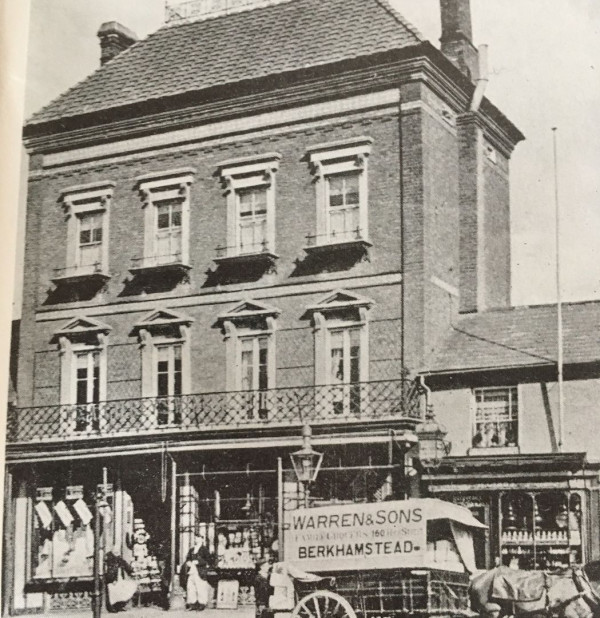
William and Richard Hazell were cousins of Hannah. Susannah Hazell (nee Butler) was the mother of William and Richard Hazell and the sister of Hannah’s father, Joseph Butler. William Hazell was a leading grocer in Berkhamsted. His premises in the High Street, one of the tallest buildings in the town, was known as “Hazell’s Folly.” The building stood on the site where W. H. Smith is now situated. He was also instrumental in promoting the building of the Town Hall, providing the site on which it was built. William Hazell’s wife Charlotte had died in 1853 and she and William had no children. His brother Richard was unmarried. The widowed Hannah became housekeeper for the Hazell brothers, no doubt a mutually convenient arrangement for both Hannah and the brothers. Charles is also noted in the 1861 census as living with the Hazells. (As are an assistant grocer, two apprentices and a domestic servant. The latter, Leah Philby, married one James Darvell and is buried with her husband in Rectory Lane cemetery.)
Percy Birtchnall, writing in the Berkhamsted Review in September 1971, wrote of William Hazell “As a grocer and pork butcher he built up a large postal business, sending his renowned sausages and hams all over the country” and that he made “a small fortune.” Did Hannah’s experience and knowledge as the widow of a pork butcher contribute in some part to his success?
In 1861, Hannah’s oldest son, William Buck, was not living with Hannah, Charles and the Hazells in Berkhamsted. He was one of four boys boarding with an Annie Bethnall in Lambeth in London. The four boys are all of a similar age and are noted as scholars. All must have been attending school in London.
William Hazell died at the age of 50 in 1868. He too is buried in Rectory Lane Cemetery. He left all of his property to Richard, save for legacies each of £200 to his three other surviving siblings. The 1871 census reveals that Richard remained in occupation of the premises in Berkhamsted High Street and Hannah continued as housekeeper there. Richard continued to employ assistant grocers and apprentices.
Charles Dickman died in 1872 at the age of 16. He was buried in the same plot in Rectory Lane Cemetery as William Hazell, being described on the headstone as William’s cousin. Eight years later in 1876, Richard Hazell followed his brother and cousin into the same grave when he died at the age of 54.
Hannah inherited the Hazell business empire. Richard, by his will, bequeathed “…all the real and personal estate to which I shall be entitled at the time of my decease unto my cousin Hannah Dickman absolutely…” Unlike William he made no gifts to his surviving siblings. Hannah, however, did not remain involved in the business for long. The 1881 census reveals that by then she had moved the short distance from the High Street to Elm Grove. She had the financial wherewithal to employ her own domestic servant and is described in the census return as a “retired grocer,” although whether she had sold the business outright or had left its management to others is not apparent. The 13 year old Sarah Hazell, a second cousin of Hannah’s, was living with Hannah and at the time of the census Hannah had a visitor staying with her, one John Earle, a 48 year old unemployed grocer. In 1871 John had been one of Richard Hazell’s assistant grocers. Ten years later in 1891 John Earle was still living in Hannah’s home, now described as a lodger and tea merchant.
By 1891 Hannah had moved, again only a short distance. From Elm Grove she had moved to Linden House in the High Street. Linden House is where Dickman’s chemist shop now stands today and the name “Linden House” still appears carved in the stonework above the door.
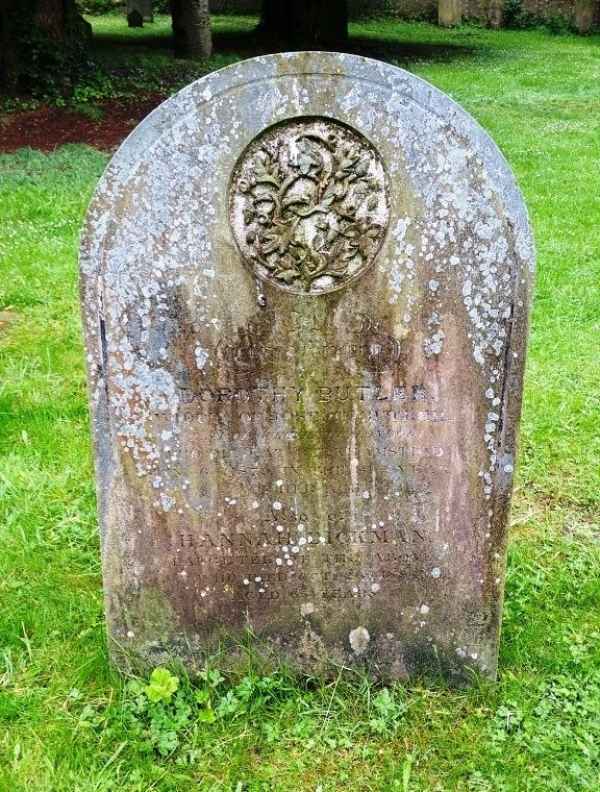
Hannah died at Linden House on the 26th October 1894 at the age of 65. Her mother, Dorothy Butler, had died in Berkhamsted on 6th January 1879, and was also buried in Rectory Lane Cemetery. Hannah was buried in the same plot as her mother, only two plots away from where Charles lies buried.
Hannah’s estate was worth the not inconsiderable sum of £10,067. That is the equivalent today of £1,300,000. The executors of her estate were her son, William Buck, John Earle, and Henry Matthews, a builder.
By her will and a codicil thereto she left £2,000 to her second cousin, Sarah Hazell together with some furniture, half of her jewellery and four houses which Hannah owned in Victoria Road. She left £100 to John Earle and £50 to Henry Matthews. To her son William she left £100, the second part of her jewellery and the shop and premises in which he was living. The remainder of her estate was placed in trust for William and his wife Sarah to enjoy the income during their lifetimes with the capital thereafter to be divided between their children.


 View burial



 Personalities of the Past
 Memorial Symbolism

 Military graves