


Plot for Hazell, Dickman, Hazell
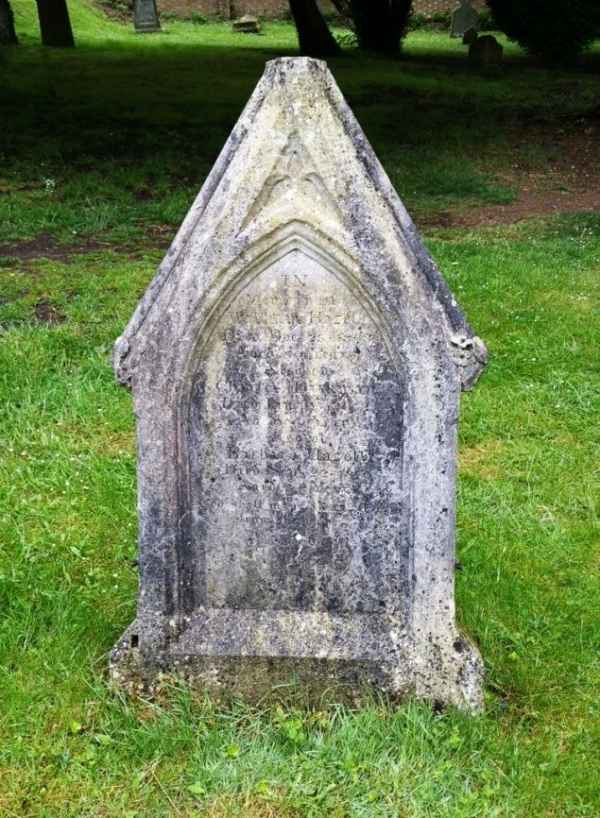
- Plot number:
19,189 - Family name:
Hazell - Burial date:
 View burial
 Who is buried here?

William Hazell
Relatives


Research:
- Christopher Dolton
WILLIAM HAZELL; 1818 -1868
William was one of nine children born to William and Susannah Hazell. William senior was the subject of a settlement examination in 1817 which gives us some detailed information about his life. The responsibility for supporting anyone who became a pauper fell on the rate payers of the parish in which the pauper was legally settled. The overseer of the poor for each parish could get rid of any paupers in his parish who had not settled there legally and were not therefore his responsibility. Settlement certificates were important in establishing a person’s place of legal settlement, and examinations were sometimes held to establish a person’s place of settlement. William senior was the subject of such an examination.
The settlement examination reveals that in about 1800 William senior was employed at the Chesham Statute fair by Edward Varney, of Newhouses, Berkhamsted, as a yearly servant for £3 a year. For the next two years he lived in various places. Then from Chesham Statute fair he went as a yearly servant, husbandman, to Robert Bainbridge of Northchurch for £5 a year. At the time of the examination he was married to Susannah and had one child, James, aged seven.
William junior was born in Berkhamsted on 20th May 1818 and was baptised on 19th July that year. He was the fourth child born to William and Susannah. Their first child James, was born in 1811 and he died in 1835; Anne was born in 1813 and died in 1817; Sarah, born in 1816 also died in 1817; William himself was next, followed by Joseph, born in 1820 who died in 1822. Richard was born in 1822, followed by John in 1825, Susannah in 1829 and finally Henry, who was born in 1831.
On 1st February 1838, William, not quite 20 years of age, married Charlotte Simmonds. The marriage took place in Berkhamsted. In the 1841 census we find Charlotte and William living in High Street, Berkhamsted, in the household of 65 year old Mary Rushworth. William was working as a grocer, the trade he was to follow throughout his life. Ten years later, we find in the 1851 census that William and Charlotte were still in the High Street, but William had set up in business as a grocer on his own account. Also living in his household, and no doubt working alongside him, was his brother Richard, who is described as a “Grocer shopman” and two young lads, 16 year old Robert Goodman and 15 year old Cornelius Fextral. The latter two are both described as servants and grocer’s lads.
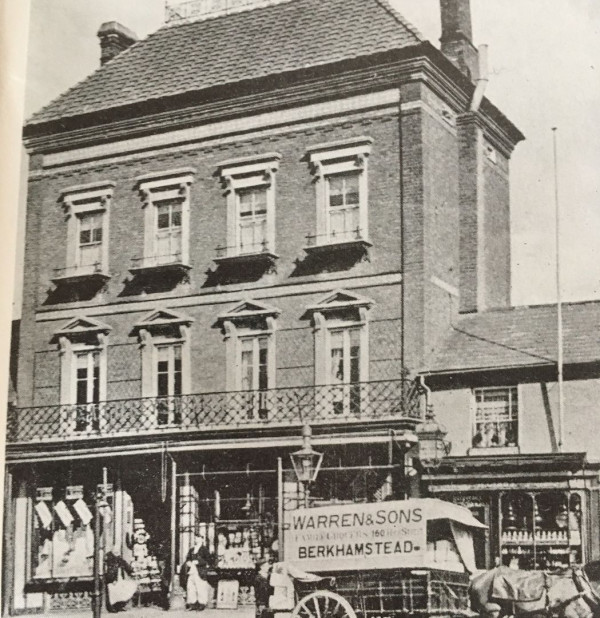
With the opening of the railway line in 1837, William believed that Berkhamsted would prosper and that he could build a successful business in the town. William’s shop stood at 178 High Street where W. H. Smith and adjacent shops now stand. William leased the site from the Grammar School and he replaced an old butcher’s shop which had stood there for many years with a shop and outbuildings which extended far behind the High Street. This was one of the tallest shops in the town and was described by Percy Birtchnell as “…the most ambitious building of its kind in the town prior to the supermarket era.” Many local townspeople, noting the extravagant size of the building, referred to it as “Hazell’s Folly”.
In addition to selling groceries, William also traded as a pork butcher. Birtchnell wrote that he set up “a large postal business, sending his renowned sausages and hams all over the country” and that he “made a small fortune” doing so.
It seems that the pig carcasses hanging alongside the shop were a sight not to be missed if the following article published in the Bucks Herald in 1867 is anything to go by:
“PRIZE PORK. – Rarely has a more extraordinary exhibition of fat hogs been seen, far or near, than is to be seen at Mr W. Hazell’s provision stores: a dozen fat pigs hung up in the passage abutting on the establishment is nothing uncommon; but none so fine at the age ever hung there before. One hog, which probably weighed little less than 50 Stone, was an animal which gained the exhibitor, Jones Lloyd Esq., £6 at the recent West Herts show…of course lovers of fat bacon should see it, and taste it, if agreeable. Mr Hazell’s is decidedly the finest Grocer’s Christmas Show in the town.”
William bought pigs for his business from as far away as Northampton, bringing them to Berkhamsted by train. As another article published in the Bucks Herald in 1866 explains, this led to “… a great and sad sensation.” Three of William’s employees, including an apprentice, Edwin Bennett, had gone to the railway line to help with the unloading of pigs from a cattle truck. An express train and a coal train were approaching from different directions and “In endeavouring to avoid the express train he [Edwin Bennett] got in the way of the coal train and was knocked down, and the train went over his right arm and leg. He was conveyed to Mr Hazell’s new house, where he expired at five o’clock on the following morning.
Edwin was himself buried in Rectory Lane Cemetery.
William may have been assisted in the pork butchery business by his cousin Hannah Dickman. William and Hannah were cousins. William’s mother Susannah Hazell, was sister to Hannah’s father, Joseph Butler. Hannah had married a London based pork butcher, William Dickman and thus would have a good knowledge of the business. William Dickman died in 1857 leaving Hannah a widow with two young sons. William Hazell’s wife, Charlotte had died in 1853. William never remarried. The couple had no children. By the time of the 1861 census, Hannah had moved to Berkhamsted and was living with William and Richard Hazell as housekeeper, a no doubt mutually beneficial arrangement.
Following the death of his wife, Charlotte, William’s relationship with his mother in law seems to have soured, judging by another article published in the Bucks Herald in 1854, the year after Charlotte died. The paper carried a report on the case of “Simmonds v Hazell.” Williams mother-in-law had loaned William the sum of £57 before Charlotte had died. The report says William paid back £7 whilst Charlotte was ill, but paid nothing further and Mrs Simmonds began legal proceedings against William to recover the balance of £50. Prior to the Married Women’s Property Act of 1882 married women were not entitled to bring legal proceedings in their own right or indeed be sued themselves. Such actions had to be brought by a husband on his wife’s behalf. Mrs Simmonds had been separated from her husband for twenty years and therefore brought action herself. It was argued on William’s behalf that the proceedings had been improperly brought as they should not have been made in Mrs Simmonds name during her husband’s lifetime. That argument found no favour with either the judge or the jury, but ultimately Mrs Simmonds still lost her case as it was considered there was insufficient evidence to substantiate the loan.
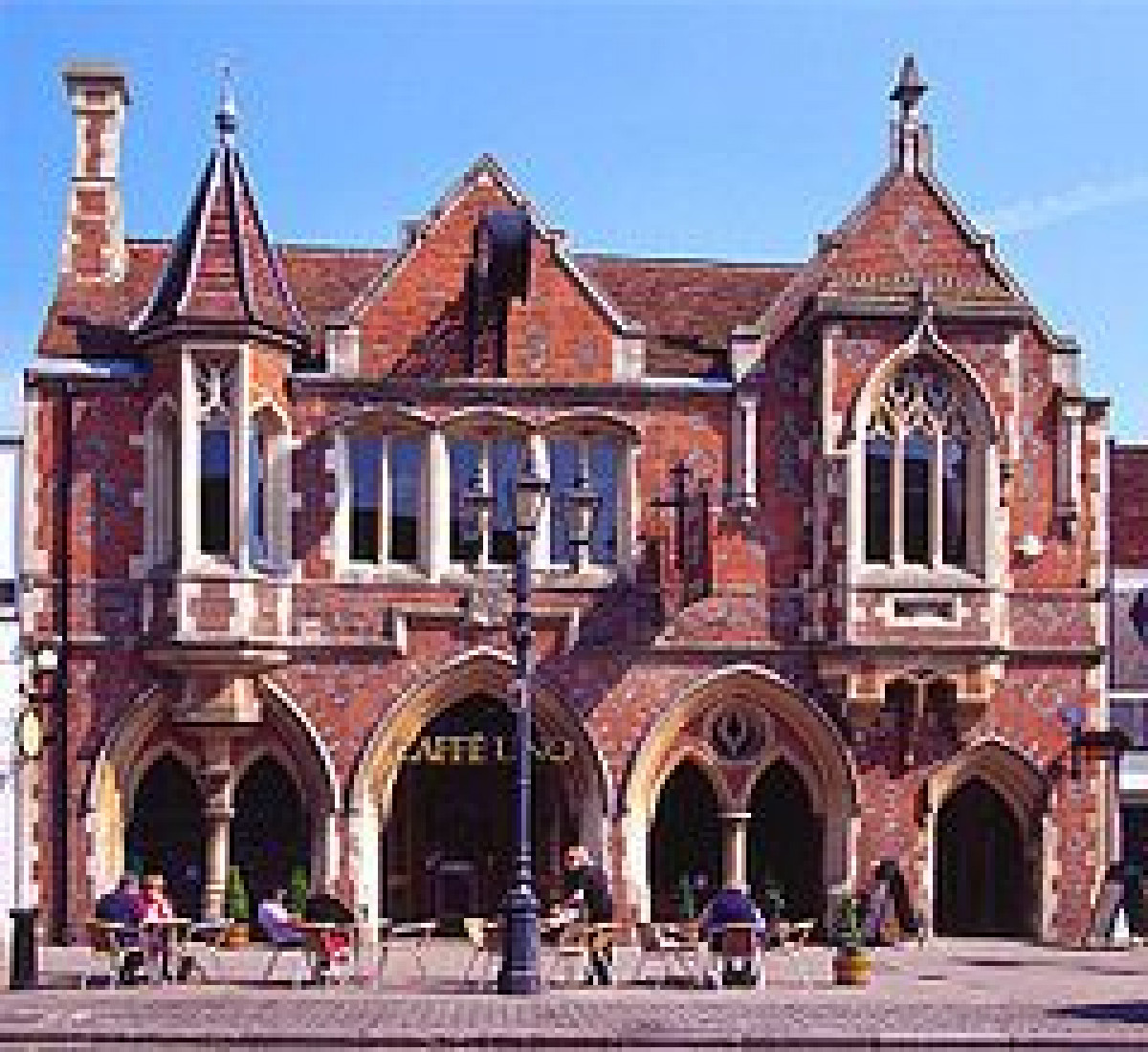
As well as pursuing his business interests, William was also active in promoting the town. In August 1854 the old market house which had stood for 250 years burned down. There were many in the town who had thought it an eyesore and there was conjecture as to whether the fire was accidental or not. A meeting was held at the Kings Arms in February 1856 to discuss the provision of a new civic building “suitable for the increasing prosperity of the town.” William had acquired a suitable site on the High Street at the cost of £823, a not inconsiderable sum, and he offered the site for the construction of a suitable building. Monies were successfully raised by public subscription and the Town Hall, which still stands in the High Street today, was officially opened in August 1860.
William was also active in promoting the gas and water companies in the town and was the unpaid surveyor of highways. Henry Nash, in his “Reminiscences of Berkhamsted” wrote highly of William and the contribution he made to the town:
“Mr Hazell often succeeded where other men failed: he was just in full vigour of life, and with a burning desire to improve his native town, he was ready to engage in enterprises that appeared impracticable to less courageous men. The more his plans were surrounded by difficulties, the more it nerved him for the fight; consequently he carried many of his projects to a successful issue. He was the chief promoter of the Gas and Water Companies, the wisdom of which is no longer called in question. The improvement in our roads and footways is also due to him. He was made surveyor and knew that clean roads and good footways were essential in making a town attractive: he therefore commenced improvements that have been followed by his successors in office until Berkhamsted will compare favourably with surrounding towns in this respect.”
An ardent supporter of Lord Brownlow, William also became embroiled in the controversy surrounding the enclosure of Berkhamsted Common
In April 1865, Lord Brownlow gave notice that he intended to enclose Berkhamsted Common under the General Enclosure Act. His estate had purchased the Manor of Berkhamsted from the Duchy of Cornwall including 1,322 acres of common land. Lord Brownlow offered to give the town of Berkhamsted 43 acres stretching from Mill Lane to Billet Lane “As a just and liberal compensation” for the loss of common rights. Opinion in the town was divided. A number of commoners signed away their rights, but a few, led by Augustus Smith of Ashlyns Hall, M.P. for Truro, objected. William Hazell was firmly in Lord Brownlow’s camp. Percy Birtchnell wrote that William “…was regarded as one of Lord Brownlow’s chief yes-men.” He was also to be described in Punch as raising “…the duteous song ‘As how a Lord like Brownlow’s Lord could never do what’s wrong.”
In August 1865, The Bucks Herald published a lengthy letter from William in support of Lord Brownlow. William wrote that Lord Brownlow had only acquired the common in order to save it from speculators and that he had not enclosed land on the other of side of his Ashridge estate which he had also acquired. William said that not “one word” had reached his ears of any intention to enclose the land and that it would be “insane as to think that Lord Brownlow’s agent would first advise the costly purchase of an extensive purlieu to Ashridge-park and then immediately destroy its value by enclosing it.” That, however, was precisely what Lord Brownlow proceeded to do in 1866 when he erected three miles of iron fencing to enclose the Common, excluding people who had exercised common rights and preventing passage along ancient trackways.
Augustus Smith resorted to the old practice of abating the enclosure by the forcible removal of all the fences. He engaged a small army of navvies who travelled out from London in a specially hired train which left Euston at midnight on 7th March. The fences were torn down.
Early the following morning William rode up to survey the damage and ascertain who was responsible. Punch published a poem about the events of that night which describes what happened next:
“In sight a horseman glides;
See on his cob, with bob, bob, bob,
The duteous Hazell rides;
To do his Lordship service
Comes riding through the mirk,
And bids the navvies let him know
Who brought them to their work.”
William did not receive the answer he was looking for. Instead, he was threatened with a dunking in the canal if he didn’t buy beer for all the navvies.
“‘Beholdest Hazell yon canal;
Would’st like to swim the same?
If not, with beer this instant
Thyself and cob redeem,’
And round him as they spoke, they drew,
And edged him near the stream.”
William evidently decided it was prudent to accede to the demand and provided beer all round:
“So down went Brownlow’s railings,
And down went Hazell’s beer.”
William died on 23rd December 1868, not in Berkhamsted where he had been born and lived all his life, but in Northampton. His death certificate not only reveals the cause of his death, “disorder of the heart,” but also tells us where he died: Northampton General Lunatic Asylum.
The asylum admission record shows that William was admitted as a patient on 6th October 1868, some two and half months before he died. The Northampton General Lunatic Asylum admitted both private patients and paupers, although when a second asylum, St Crispin’s, was opened in Northampton specifically for paupers, the asylum became Northampton General Lunatic Asylum for the Middle and Upper Classes. William was admitted as a private patient.
The asylum report for the year 1868 gives us some idea of the regimen. The patients enjoyed regular concerts, theatricals and cricket matches. There were weekly dances and divine service twice weekly. Some of the patients had been taken on holiday to Lowestoft. William would not have gone hungry. Private patients were allocated the following each week: 6lbs uncooked meat; 7lbs vegetables; 7lbs bread; 12oz cheese; 10 ½ pints of beer; 8oz butter; 2oz tea; 8oz sugar; 1 ½ pint of milk; pudding 4 times a week; fresh fish, poultry and fruit when in season. The fees were between £2. 2s. and £4. 4s. per week depending on circumstances.
Admission required an Order for Admission to be signed by one of the patient’s relatives or friends and two certified medical practitioners had to certify the patient as being of unsound mind.
The records relating to William’s admission and treatment are held by Northamptonshire Archive Service and reveal the reasons for William’s admission to the asylum. He had been “Constantly rambling in his speech from one thing to another without any connection of events- says that he expects 50 persons to dinner which is not the case / tears his shirts to pieces, calls himself mad Billey & says he will have a straight-waistcoat for a trademark. Says he is starved when he has as much food as he can take. He has broken a basin and cup by throwing them about.” William was said to be “dangerous”.
Despite his protestations that he was being starved, William was described on admission as “A man of medium height, stoutly built & well nourished.” He had “thin sandy hair and whiskers, head fairly shaped & of good capacity…intelligent features….” He displayed “considerable anxiety about his business and has been in the habit of drinking freely.” He was said to be “…extremely excited and talkative…” and in contradiction to the earlier assertion that he was dangerous, he “…appears to be good humoured & does not show any disposition to violence.”
William’s mental condition improved after admission. He became less excited and anxious, but his physical condition deteriorated. He lost weight and symptoms of heart disease showed themselves. William died at 2.30 a.m. on 23rd December 1868 of heart disease and dropsy.
Although William died in Northampton, his body was brought back to Berkhamsted and he was buried in Rectory Lane Cemetery. William’s wife Charlotte had been buried in Rectory Lane Cemetery when she had died in 1853, and she was joined in 1856 when William’s sister Susannah died, William did not join her in the same grave. Presumably there was not room enough. He was buried in a new plot in the cemetery. He was to be joined in his grave by Hannah Dickman’s 16 year old son Charles when he died in 1872 and also by his brother Richard when he died in 1876.
William’s property was worth under £5,000, including not only his business but also freehold houses and premises in Castle Street which he owned jointly with his brother Richard. He left £200 to each of his brothers, John and Henry and his sister Susannah. The remainder of his estate was left to Richard.
Charles Dickman
Relatives
Research:
- Christopher Dolton
CHARLES DICKMAN: 1856-1876
Charles was the second child born to Hannah and William Dickman, a master pork butcher. His older brother, William Buck Dickman had been born in 1850. Charles was born at High Street, Berkhamsted, on 10th January 1856.
In 1851 Hannah and her husband William were living in Marylebone, London. The fact that Charles was born in Berkhamsted suggests that Hannah may have moved to the town by that date and we know from the census of 1861 that she and Charles were then living in Berkhamsted High Street with William Hazell and his brother Richard, cousins of Hannah. Charles’ father, William, had died in 1858, two years after the birth of Charles, but he died in London, not in Berkhamsted, his death being registered in Bethnall Green. It is not clear whether Hannah moved to Berkhamsted whilst William remained in London, or whether William accompanied her and later died in London.
Like his older brother, William Buck, Charles was educated away from home, but whilst William Buck boarded in Lambeth, the 1871 census tells us that Charles, then 15 years old, was a pupil boarding at Trinity School in Old Stratford, Northamptonshire.
John Thomas of Wendover purchased the school, then known as Belvedere House, and reopened it in 1854, it having been closed a few years earlier. In 1857, Thomas’ son, the Revd. James Thomas, took over the school, which took both day boys and boarders and in the 1860s was renamed Trinity School. In 1885 the bishop of Peterborough and the rectors of Wicken and Passenham were described as the school’s ‘visitors’; the classrooms and dormitories were said to be ‘lofty and well arranged’; the eight acres of grounds included facilities for football, cricket and tennis; there was a swimming bath; and the school had its own dairy. The fees were 35 guineas a term, ‘strictly inclusive’. The school closed in 1894.
Charles died one year later on 15th January 1872, a few days after his sixteenth birthday. His death certificate reveals that he had enteritis and died of a perforated bowel. He was buried in Rectory Lane Cemetery in the same grave in which his mother’s cousin, William Hazell, had been buried when he died in 1868. William Hazell’s brother, Richard was also buried in the same grave when he died later in 1876.
Richard Hazell
Relatives
Research:
- Christopher Dolton
RICHARD HAZELL; 1822 – 1876
Richard was the sixth child born to William and Susannah Hazell. He was born in 1822 and was baptised in Berkhamsted on 6th October 1822. William and Susannah’s first child, James, was born in 1811 and he died in 1835; Anne was born in 1813 and died in 1817; Sarah, born in 1816 also died in 1817; William was born in 1818, followed by Joseph, born in 1820 died in 1822. Richard was born in 1822, followed by John in 1825, Susannah in 1829 and finally Henry, who was born in 1831
Richard’s father, William, was the subject of a settlement examination in 1817 which gives us some detailed information about William’s life.
The responsibility for supporting anyone who became a pauper fell on the rate payers of the parish in which the pauper was legally settled. The overseer of the poor for each parish could get rid of any paupers in his parish who had not settled there legally and were not therefore his responsibility. Settlement certificates were important in establishing a person’s place of legal settlement, and examinations were sometimes held to establish a person’s place of settlement. William was the subject of such an examination in Berkhamsted in 1817.
The settlement examination reveals that in about 1800 William was employed at the Chesham Statute fair by Edward Varney, of Newhouses, Berkhamsted, as a yearly servant for £3 a year. For the next two years he lived in various places. Then from Chesham Statute fair he went as a yearly servant, husbandman, to Robert Bainbridge of Northchurch for £5 a year. At the time of the examination, he was married to Susannah and had one child, James, aged seven.
In the 1841 census we find Richard, at the age of 20 years, living in Mill Street in Berkhamsted. He was then working as a labourer, but he didn’t remain in that occupation for long. His elder brother William had started in business as a grocer and pork butcher in the High Street and the 1851 census tells us that by that date Richard had joined him and was working as an assistant grocer in William’s shop. In fact, we know from a report published in the Bucks Herald dated 2nd February 1847 that Richard had already joined William by that date and was working alongside him in the grocery business. The article describes an attempt by an eight year old “urchin”, Charles Groves, to steal half a crown from the shop till. Richard had left the shop to go for his breakfast in an adjoining room leaving half a crown and some silver and coppers in the till. A few moments later he heard “a noise as if someone was shutting the till;” He immediately went into the shop and caught the young Groves coming from behind the counter. Richard “…laid hold of him, and said to him, you young rascal, when he moved a step or two and dropped the half crown….and he held him until the police came.”
Although something of a digression, the fate that befell the young Charles Groves reveals much about the harshness of Victorian criminal law. Charles was one of five children born to Cutler and Susan Groves. The family lived at the back of the High Street. His father was a labourer and later records tell us that Charles, young as he was and like many other children of poor families, worked as a straw plaiter.
Following his arrest, Charles appeared before Magistrates. The report in the Bucks Herald records that Charles, in tears, asked for forgiveness and promised not to do it again. He was committed for trial at the Hertford Assizes and on the 2nd March 1847, at the age of 8 was sentenced to transportation to Van Dieman’s Land (Tasmania) to serve a sentence of seven years.
Even the Victorian penal system baulked at transporting an eight year old boy. The Inspectors of Millbank prison, where prisoners were held pending transportation, decided that due to his “tender years” Charles was unfit for transportation. That, however, merely delayed his voyage. In the interim, he was held at Parkhurst prison and he was eventually transported at the age of 12, presumably no longer considered to be of “tender years”. He sailed for Van Dieman’s Land aboard the convict ship “Nile”. The ship left Portland on 16th June 1850 and docked at Hobart nearly four months later on 3rd October 1850.
Happily (if such a term can be used in such circumstances), by the time of his arrival in Hobart, Charles had served sufficient of his seven years sentence to be eligible for a “ticket of leave.” Such tickets, given to those who it was thought could be trusted and as a reward for good behaviour, permitted the holders to seek employment within a specified district, but not leave it without permission and ticket holders could be recalled if they misbehaved. Charles was given his ticket of leave on 12th October 1850, 9 days after landing. Just over four years later, on 20th January 1855 and still only 16 years old, he had completed his sentence and was given his certificate of freedom.
Returning to Richard’s story, the census of 1861 discloses that Richard and William had been joined in Berkhamsted by their cousin Hannah Dickman and her youngest son, Charles. Richard and William’s mother Susannah Hazell, was sister to Hannah’s father, Joseph Butler. Hannah had married a London based pork butcher, William Dickman. William Dickman died in 1857 leaving Hannah a widow with two young sons. William Hazell had married in 1838, but his wife, Charlotte had died in 1853. Richard never married. The 1861 census reveals that Hannah was living with the Hazell brothers as their housekeeper, a no doubt mutually beneficial arrangement. The knowledge that she must have gained from her husband of the pork butchery business was also probably of great help to the Hazell brothers.
William died in 1868 at the age of 50 and was buried in Rectory Lane Cemetery. He left his business and all his property to Richard, save for three legacies, each of £200 which he left to his other siblings, John, Henry and Susannah.
The 1871 census reveals that Richard, 48 years old, was then head of the household. His occupation is noted as “Grocer and provisions merchant.” His household was sizeable. His cousin, Hannah Dickman was still living with him as housekeeper (her son Charles was to die in 1872 and was buried with William Hazell.) Also at the property was William Fordom, a corn merchant; John Earle, a “shopman/clerk”; three apprentices, George Bailey, James Cook and James Clarke; Elijah Quarrington, a poulterer and finally 14 year old Mary Gristwood a domestic servant.
Following his brother William’s death, Richard took William Fordom on as his partner in the business. William Fordom managed the Berkhamsted shop, although the partnership did not last long as William Fordom died in December 1871 at the age of 32 years. He too is buried in Rectory Lane Cemetery.
The Bucks Herald reported in 1870 that Richard, as William Hazell’s executor, sued the The London and North Western Railway company alleging the company’s negligence had damaged fifteen cheddar cheeses worth £8. 16s. William Fordom presented the case, but the claim ultimately failed, the judge deciding that there was no evidence that the railway company had been negligent.
As well as the shop in Berkhamsted, a branch was opened in Tring. Hogs had been exhibited in William Hazell’s day at the annual Christmas food fair, a tradition which Richard and William Fordom continued. If anything, as an article published in the Bucks Herald in 1869 reveals, the hogs were bigger and even more impressive than in William’s day:
“CHRISTMAS FARE.- Some excellent cheer for Christmas is being exhibited in the town…the most noteworthy show and the finest ever seen in Berkhampstead is that at Mr Hazell’s establishment. Mr Hazell and Mr Fardom [sic] have about fifty very superior fat hogs hung up for show, including a very superior one fattened by Lord Chesham, another immense animal weighing 75 stone, when alive upwards of 98 stone, from Lord Rokeby’s farm near Watford…It would hardly be possible to see a finer collection of pork…”
And in 1870 the same paper reported another theft from the shop:
STEALING A PIG’S HEAD.- On Monday at the Herts Quarter Sessions, Joseph Pooley, of Northchurch, was sentenced to seven years’ penal servitude for stealing a pig’s head from the shop of Mr Hazell…”
At least Joseph Pooley avoided transportation which had ended in 1853.
Like his brother William, Richard was also involved in the town gas company and was a director of the company.
Richard died in Berkhamsted on 22nd September 1876. He, like William, died at a relatively young age. The cause of his death was a softening of the brain and heart disease. He was 54 years old and he joined William and Charles Dickman in the same grave in Rectory Lane Cemetery. Given he had started out as a labourer, Richard had done well for himself. His estate was worth under £6,000 and he left it all to his cousin Hannah Dickman.

Do you know these people?
If you have any memories, family history or photographs that could help us to build up more information about these burials, please contact us - we would love to hear from you.
If you have any memories, family history or photographs that could help us to build up more information about these burials, please contact us - we would love to hear from you.
Memorial details
| Family name | Hazell |
| Burial date | Not known |
| Burial capacity | Not known |
| Burial depth | Not known |
| From burial books? | |
| Burial visible (2019)? | |
| Burial visible (1991)? |
Condition: good
Photos
In Memoriam
If you have a family or other connection with anyone buried in this plot, you are welcome to post your memories or photographs here.
 Personalities of the Past
 Memorial Symbolism

 Military graves