03/01/1830 –17/10/1905
Timber merchant, JP, Chairman of Berkhamsted School Board, President of local Free Church Council
Relatives
Research:
JOSIAH EAST; 1830-1905
Josiah was born in Chesham on the 3rd January 1830. His parents were Job and Mary East (nee Wells). We know from non-conformist church records that Josiah’s parents were Baptists and Josiah was later to become an active and prominent member of the non-conformist church.
The 1841 census tells us Josiah was one of 4 children born to Job and Mary. Their eldest child was a daughter, Mary, born in 1828, followed by Josiah born in 1830. His two younger brothers were Cornelius, born in 1832 and Edwin, born 1837. At the time of the 1841 census the family were living in the High Street, Chesham.
Josiah’s father, Job, like his father before him, William East, was a wood turner. Wood turning was a common occupation in the area and wood-workers passed their skills from one generation to the other. William Ellis , a Little Gaddesden farmer and writer noted that “The Berkhamsted and Cheshunt turners of hollow ware… make more consumption of this wood [alder] and beech than any other two towns in Great Britain, as is allowed by good judges: for with this wood they make dishes, bowls, and many other serviceable goods that are lighter and softer than the beech or elm, and will bear turning thinner than most others, so that to please curiosity, a dish of it has been turned inside out like a hat…”
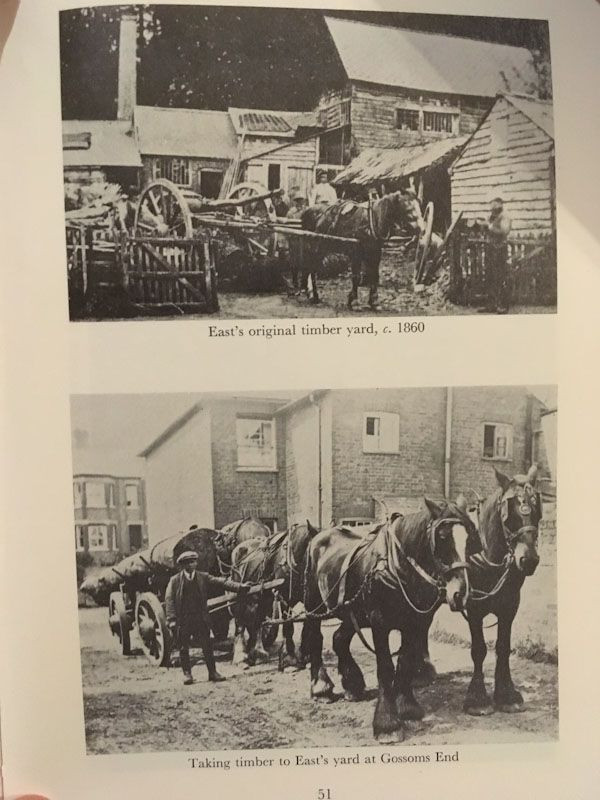
Job and his family moved to Berkhamsted from Chesham in the early 1840’s and took over a small shovel making and wood turning business. Percy Birtchnell, writing as Beorcham, published an article in the Berkhamsted Review “Why East’s went west to Gossom’s End – Berkhamsted oldest business”. This article describes how Job East took over an existing wood yard in Berkhamsted belonging to Thomas Haywood. The article says this was in 1840, although as we have seen above, the 1841 census records that East family were then still living in Chesham. The yard was originally at the east end of the High Street, but later moved to Gossom’s End. (The site is now occupied by Jewsons Builders’ Merchants.) Percy Birtchnell writes this was because a local neighbour, Mr Constable Curtis of Berkhamsted Hall, objected to the smoke from a tall chimney sprouting from one of East’s sheds.
Job, with the help of Josiah and Cornelius, developed the business. With the outbreak of the Crimean War in 1853, they won contracts to supply the army with lance poles, artillery rammers, shaving bowls, tent pegs and poles and the business grew from employing 10 men to nearly 100.
It was also in 1853 that Josiah married. He married on 23rd March 1853 and his bride was Elizabeth Bassill. Cornelius was to marry Elizabeth’s sister, Susannah, in 1855.
Josiah, however, moved on from Berkhamsted, leaving Cornelius to run the yard at Gossom’s End. Josiah moved to east London where he set up his own timber business. The 1861 census reveals that Josiah was living at 4 Waterloo Terrace, Stepney. He is described as a “Timber merchant and shop merchant (master employing 6 men and 1 boy)”.
Josiah and Elizabeth were to have five children, Alfred, born in 1855; Elizabeth and Emmeline Charlotte, twins born in 1861 (Somewhat confusingly she is named as Charlotte in the 1861 census, but as Emmeline in all subsequent censuses.) Frank was born in 1863 and the youngest child, Clement, was born in 1867. Clement died at the age 8 in 1875.
In 1871 the family were living at 2 Fillbrook Road in Leyton. In 1881 the family were still in Leyton but then at Clansholm, 1 Wallwood Road where they were also living in 1891.
Elizabeth died in 1884. Although she is named on Josiah’s headstone in Rectory Lane cemetery, she is not in fact buried there. As Josiah’s memorial records, she was interred in Ilford cemetery. Josiah did not remarry and lived the rest of his life in the company of his daughter Emmeline.
Contemporary newspaper articles give us some information about Josiah’s business. An article in the Chelmsford Chronicle, published in 1883, describes the sale of 545 trees. Josiah is mentioned as one of the principal buyers of the timber. An article published two years later in the Morning Post in September 1885 reveals that Josiah and others owned a timber yard at Britannia Wharf in Limehouse, London. The article describes an accident which occurred at the wharf in which lifting gear used to move a heavy tree collapsed and injured six men.
Josiah was evidently a prominent and respected figure, both in business and in liberal politics. In February 1895 he was appointed as a Justice of the Peace for the county of London. A notice of this appointment published in the Bucks Herald describes Josiah as “… well-known and highly respected as a large employer of labour in the East End of London, where he is chairman of the local liberal association and an active worker. Fifty years ago he came over as a lad from Chesham to manage a small business in wooden ware started by his father Mr Job East, near the Hall, Berkhampstead, and subsequently removed to Gossom’s End, where it has grown under the direction of Mr Cornelius East into an important local industry. Mr Josiah East went to London, and in addition to his own large business, now in the capable hands of his sons, is a trustee by an order in Chancery of another large undertaking.”
It seems from the above article that by 1895, at the age of 65, Josiah had handed the reins of his London business over to his sons. An article published in the Herts Advertiser dated 3rd August 1895 reveals that at that time Josiah attended a meeting at the Berkhamsted Mechanic’s Institute to discuss arrangements to celebrate the Institute’s 50th anniversary, suggesting that he had by then moved back to Berkhamsted.
Berkhamsted Mechanic’s Institute was the town’s oldest independent society and had been founded in 1845 with a series of inaugural lectures. A reading room was provided in the Town Hall when the Town Hall opened in 1860. The purpose of the Institute was to provide education for all. Evening classes were provided in a wide range of subjects. As well as putting on lectures, the institute organised an annual exhibition of arts and crafts. The term “Mechanics” was dropped from the title in 1930 and it was not until 1993 that the Berkhamsted Institute was finally wound up.
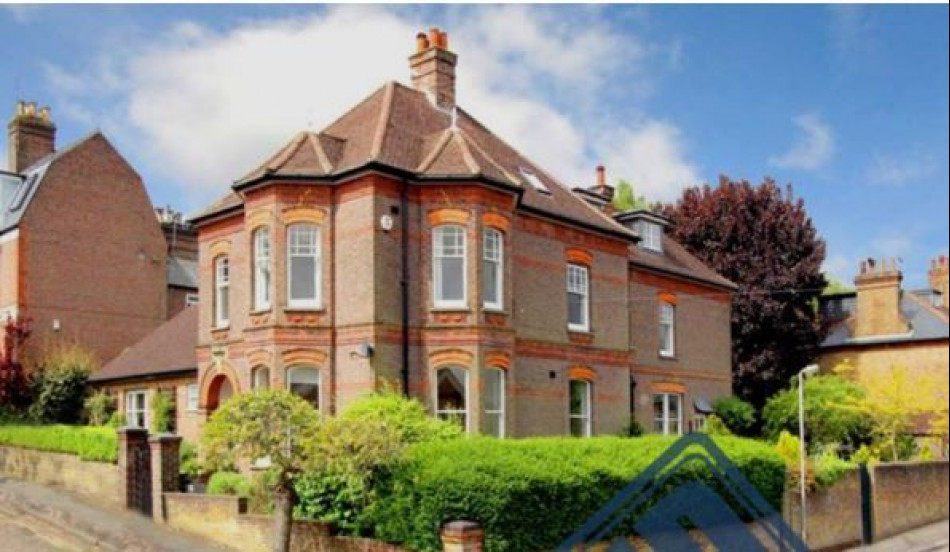
Josiah certainly settled back in Berkhamsted by 1897 as the Electoral Register for that year records that Josiah was then living in Cowper Road. The census for 1901 gives his address as Cowper House, Cowper Road. Living with him was his daughter Emmeline and also a domestic servant.
Josiah was not only involved with the Mechanics’ Institute, but he was also the chairman of the Berkhamsted School Board. In 1833 the Parish Vestry, which until the end of the 19th century was responsible for the development of the town, public health and support for the poor, supported a resolution proposed by Augustus Smith of Ashlyns Hall, “that a good parish school should be established, where both boys and girls should be taught reading, writing, arithmetic and useful work.” What was known as the British, or Chalk School was opened at the corner of Park View Road in 1834. This school later became known as the Board School. Pupils had to pay “the school pence” between 1d and 3d towards the cost of the school. The very poorest could apply for exemption from the school pence.
Josiah was active in non-conformist circles as President of the local Free Church Council. An article published in the Bucks Herald in December 1900 tells us that Josiah was also superintendent of the Baptist Boys Sunday School. Even though he was then 70 years old, travel was evidently no obstacle to Josiah. The same article reports that he was presented with a bible to welcome him back from a trip he and his daughter, presumably Emmeline, had taken to North America, no mean feat in the days before air travel.
He died on 17th October 1905 at the age of 77, his estate being valued at £20,589. Taking inflation into account, that is equivalent to £2,500,000 today. Josiah in the 77 years of his life had come a long way from his humble origins as the son of a wood turner.


 View burial


 Personalities of the Past
 Memorial Symbolism

 Military graves