1844 –30/12/1927
Niece of Charlotte Flint; a straw plaiter and later a domestic servant at the the Rectory
Relatives
Research:
ELIZA ELLENS
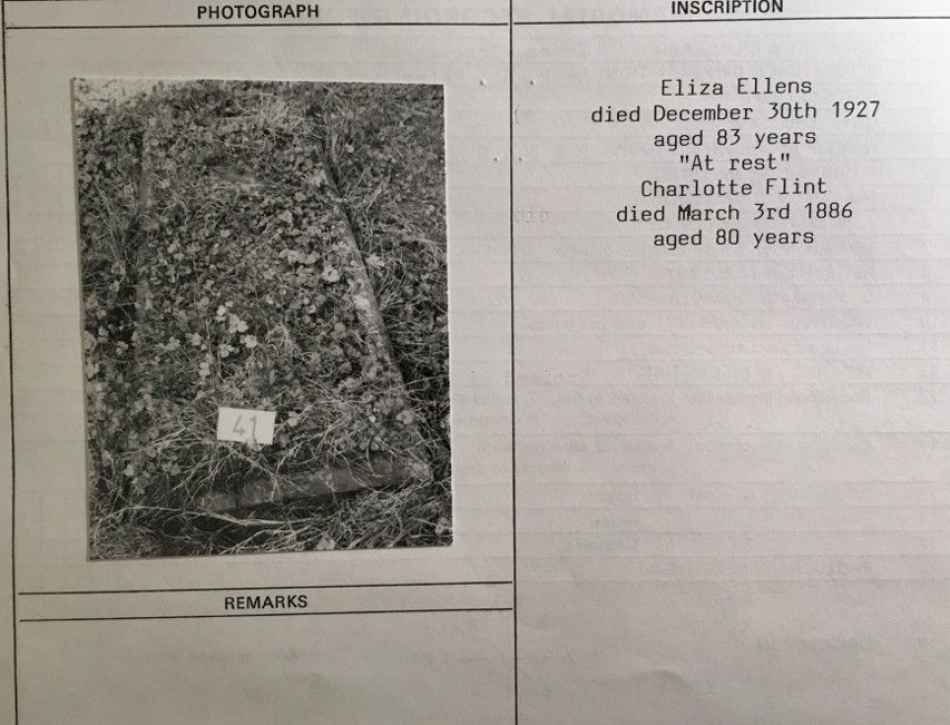
Eliza Ellens lived her whole life as a spinster in Berkhamsted. She was born in 1844 and died aged 83 on 30 December 1927. In the 1871 Census, when Eliza was aged 27, she was described, for the first and only time in the census data, as deaf. Her parents, Caroline, nee Flint, and Thomas Ellens, married in Birmingham in1825. Eliza was the fourth of their five children, but her father died in 1850, when she was a young child. Her younger sister, Emma, also appears to have died not long after Thomas’s death.
Although Eliza’s parents married in Birmingham, there is no trace of the family living in Birmingham and the 1841 Census shows Caroline living in the household of her brother, Henry Flint and her sister Charlotte Flint in High St Berkhamsted. All three of Eliza’s older brothers are also in the household and all are described as having been born in Berkhamsted. This was some time before Thomas’s death in 1850, but he is not traceable in the census data either in Berkhamsted or Birmingham.
This living arrangement was still in place after Thomas’s death according to the 1851 Census. Two of Eliza’s older brothers are still in the household and Eliza also has a baby nephew living there. He was born in Middlesex and is presumably the child of her older brother William, then aged about 22, as he is the only brother described as being married. There is no mention of his wife being in the household either then or in later years. The wage earners at this point in Eliza’s life appear to be her mother, Caroline, and her maternal aunt, Charlotte Flint. Both are laundresses.
At some point during the years between 1851 and the 1861 Eliza started to work as a straw plaiter and continued to do so until at least 1881. Straw plaiting was a significant local, mainly cottage, industry in Berkhamsted in the mid-Victorian period. The plaited straw was sold to hat makers in Luton and Dunstable. The work was regular, and the wages were relatively good – more than those available to agricultural workers. It seems likely that Eliza started work when she was as young as 8 although other children at the time started at an even younger age. There was no right to a basic education for Eliza’s generation of children. She may have attended one of the local “plait schools” to learn her trade, particularly as her mother and her aunt were not straw plaiters. At the time there were three such schools in Bridge Street, close to her home. These schools were much more akin to “sweat shops”. Given that Eliza must have spent over 20 years as a plaiter, it is a tribute to her resilience that she was 83 and living relatively independently when she died as the plaiting industry was associated with serious health conditions such as tuberculosis and mouth cancer
In 1864 Eliza’s mother died in her mid-fifties. Nevertheless, during this period in the early to mid 1860s the household grows larger. By 1871 there are additional nephews and nieces living in the High Street. They are presumably Eliza’s brother William’s family. However, none of Eliza’s brothers are living in the household in 1871 so after Caroline’s death, Eliza and Charlotte appear to be the main wage earners for this expanding household. Possibly Eliza’s brothers were living and earning a wage elsewhere and William relied on his spinster sister and great aunt to help with his children.
By 1881 only one of Eliza’s nephews remains in the household. Caroline and Charlotte are still in High Street Berkhamsted working as a laundress and a straw plaiter.
In 1886, Charlotte died. Eliza was 42 at this point and her Aunt Charlotte had been a consistent figure throughout her childhood and early adulthood. It seems likely that she lost her home in the High Street because of Charlotte’s death. In the 1991 Census she is living in Ellesmere Road in the Sunnyside Parish of Berkhamsted and is described as a caretaker and “head”. It looks as though she is sharing lodgings with another domestic servant described as a “house parlour maid”. They may simply be sharing lodgings, or they might work for the same employer.
It is not clear how long this employment continued. By this time straw plaiting was in decline as an industry and it seems likely that Eliza continued to pursue work in domestic service as, by 1901, she is a housemaid at the Rectory of St Peters in the High Street. Her employer is Arthur Johnson, the Rector of St Peters between 1883 and 1902. Eliza was had certainly moved into the Rectory by 1889 as the Bucks Herald of that year reports her as being the recipient of the Rector’s annual Easter gift. It was a generous gift amounting to one pound, 10 shillings and sixpence. In the 1860s Eliza probably earned around fifteen shillings a week as a straw plaiter.
Arthur Johnson is strongly associated with the Rectory Lane Cemetery. Like Eliza, he is buried there. He was the Rector in Berkhamsted for nearly 20 years and in 1894 he donated an acre of the Rectory Garden to allow the cemetery to be extended.
It is not clear as to whether Eliza stayed on at the Rectory after Arthur Johnson left to take up a living in Yorkshire. It seems more likely that as a family servant she had to find work elsewhere. In 1911, aged 66, she is living at 45 High Street. This seems to be her home as she is described as “head of household” and is working as a “charwoman”. By 1921, aged 76, apparently living alone, she is still at 45 High Street and described as having “no occupation”. Eliza certainly had a long, and probably quite tough, working life, achieving eventually a degree of independence and dying aged 83 in 1927.
Liz Railton
13 November 2025


 View burial


 Personalities of the Past
 Memorial Symbolism

 Military graves