


Plot for Smith and de Fraine
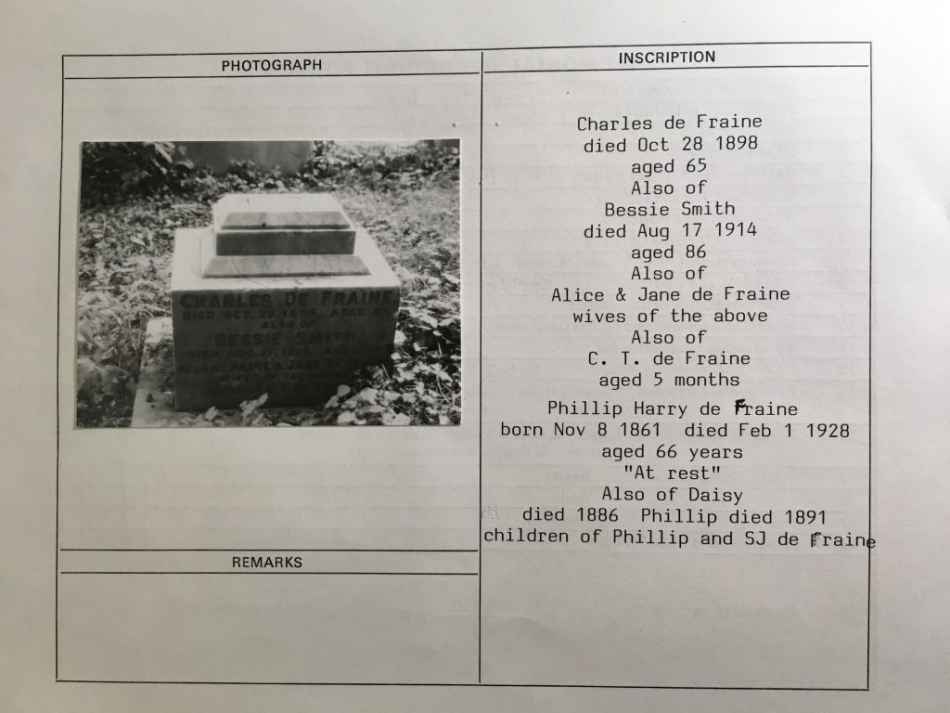
- Plot number:
17,188 - Family name:
Fraine - Burial date:
06/07/1883
 View burial
 Who is buried here?

C. T. de Fraine
Died age 5 months

Jane de Fraine
Relatives
Research:
- Christopher Dolton
JANE DE FRAINE; 1842 – 1883
Jane was born in or about 1842 at Water End, Hemel Hempstead. Her father was Alfred George, a baker and her mother was Eliza George. By the time of the census of 1851, Jane’s father had died and her mother had re married; her second husband, Frederick Sternes, was a labourer who worked in an iron foundry. Jane was to have six children with Frederick.
A photograph dating from the 19th century shows John Pethybridge’s premises on Berkhamsted’s High Street. Evident in the photograph is a gateway in the centre of the building. Local historian Percy Birtchnell wrote that the gateway led “…through to the coachmaker’s yard in the middle of the building. In 1851 four families lived ‘Yard In’, an arrangement which was still evident in the 1891 census.” It was in one of those four cottages that the Sternes family lived in 1851. However, by 1861 the family had moved to a cottage in Water Lane.
Jane married at the age of 25 on 3rd February 1867. Her husband was local hairdresser, Charles de Fraine. Charles was 34 years old and a widower. His first wife, Ann, had died in 1863 leaving Charles with the care of two young children. Following her marriage to Charles, Jane was to have two children herself, Chester, born in 1868 and Adelaide Eliza, born in 1874.
Jane herself died in 1883 at the age of 41.
Alice de Fraine
Relatives
Research:
- Christopher Dolton
ALICE DE FRAINE; 1830 – 1863
Alice was not local to Berkhamsted; she was born in 1830 in Port Carlisle, Northumberland. Her parents were Christopher and Isabella Robinson. Her father was an agricultural labourer. By the date of the 1841 census, the family had moved to the village of Sebergham, also inNorthumberland. Ten years later, Alice, then 21 years of age, had left both the family home and Northumberland. She was living with the family of James Clews, who farmed 125 acres in Stone, Staffordshire. Alice was working as a dairy maid.
Ann married Charles de Fraine in Berkhamsted in 1856. How the she and Charles met is not evident. Charles been born in Berkhamsted worked with his father in the family hairdressing business. Given that Ann and Charles married in Berkhamsted, it may be that Ann had moved to the area from Staffordshire for the purposes of work.
Alice gave birth to her first child, a son, William Christopher in or about 1857. Sadly, William did not survive infancy, dying in 1858. Alice had a second child in 1859, Alice Fanny, and her third, Philip Henry, who was born in 1861.
Alice died in 1863 at the age of 33.
Bessie Smith
Relatives


Research:
- Christopher Dolton
BESSIE SMITH; 1830 – 1914,
Bessie Smith, née De Fraine, was the fifth of eight children[1] born to William and Ann de Fraine. William had been born in Aylesbury, but he had moved to Berkhamsted where he set up in business as a perfumier and hairdresser. The family home and hairdresser’s shop was located on Berkhamsted’s High Street, one of two cottages situated between the Swan and Crown inns. Bessie was born in Berkhamsted on 10th October 1830 and baptised at St Peter’s church on 2nd January 1831. Her name is given as “Betsy” in the census returns of 1841 through until 187, although thereafter she is referred to as “Bessie”.
In 1851, at the age of 20, Bessie had left the family home in Berkhamsted. She and her older sister, Ann, were living in lodgings together in Dunstable where they both worked as straw plaiters.
Straw-plaiting was a profitable cottage in the Berkhamsted region in Victorian times, supplying plaited straw to the hat makers of Luton and Dunstable. It was work predominantly undertaken by women and children. In 1851 45% of women working in Berkhamsted were engaged in plaiting straw and in the more rural areas, as one might expect, the percentage was higher; in Frithsden, it was 89%.
The work was well paid and a woman working at home could earn more than a labourer. “…it was a profitable occupation and in the first half of the 19th century many women and children earned more than men who laboured in the fields. A good hand at Berkhamsted could earn about 15s a week-then a handsome wage-…Farmers complained that straw plaiting “did mischief, making the poor saucy, rendering the women adverse to husbandry and causing a dearth of indoor servants and field labourers.” (Birtchnell, A Short History of Berkhamsted.) Nash commented that without the income to be earned from straw plaiting, “it is hard to say what would have been the condition of the labouring class had not their incomes been supplemented by this means.”
In 1851 in Berkhamsted and the surrounding areas,16% of all boys between the age of 5 and 9 were working and 26% of all girls. Of those, 13% of the boys were plaiting straw and 24% of the girls. Between the ages of 10 and 14, 44% of boys worked, of whom 15% were straw plaiters and 56% of girls worked, 45% of those being engaged in plaiting straw. (Goose, N Population, economy and family structure in Hertfordshire in 1851, Vol. 1, The Berkhamsted region, 1996.)
Whilst the straw plait trade had a positive impact on family incomes, it had a deleterious effect on the education of children. The craft was passed on from generation to generation. Children started straw plaiting at the age of 5 and were sent to dame schools to learn the craft. Straw plait schools were commonly held in ordinary cottages, and Mrs Wimbush’s school in Northchurch was probably typical in that the Children’s Employment Commission of 1864 found it to be overcrowded, close and heavy in atmosphere. In Berkhamsted at one time there were three plait schools in Bridge Street alone.
Little attention was paid to the education of the children. Parents, understandably preferred to put their children to work to supplement the family income rather than sending them to school. The Second Report of the Children’s Employment Commission, published in 1843, reported that “This plaiting is a complete bar to anything like education, for as soon as children can use their fingers they are put to it” and that the only way to encourage school attendance was by inclusion of plaiting in the curriculum. Some schools in an effort to encourage parents to send their children to school permitted “half-time plaiters” but were plagued by disruptive behaviour and repeated absences during busy times of the plaiting trade. In 1866 the managers of the then new National School in Northchurch reported that “The unsatisfactory experiment of admitting straw plaiters among the infants be discontinued” and “that for the future the plaiters be separated and placed in the classroom of the infants School.” (Hosier, Hedghog’s Nortchurch.)
Whereas in the 17th century literacy rates had been highest in Northern England, by the 1840’s this was reversed. Bedfordshire and Hertfordshire had the lowest rates of all the counties in England, with Hertfordshire being the worst. This was the price paid for the additional income produced by the straw plait trade.
Ten years later in 1861, Bessie was no longer plaiting straw for a living. She had returned to live with her elderly parents at their home on Berkhamsted’s High Street. Her father was then 60 years old and her mother 64. Bessie was probably caring for them. Her mother died four years later in 1865, and her father died in 1879. However, by 1871 she was living in Islington, back with her sister Ann who had married William Cheeke, and their three children. William was a warehouseman and Bessie must have found employment in the same warehouse in which William worked as her occupation in the 1871 census is given as “warehousewoman”.
On the 14th March 1887, at the age of 56, Bessie married. Her husband was 73 years old James Smith, a widower, who lived in the parish of Widcombe, Somerset. The marriage certificate describes James as a “gentleman”. His father, who was deceased had been a coach builder. The wedding was celebrated at the Widcombe Parish Church. Perhaps not surprisingly given the age of the groom, the marriage was not to be a long one. Four years later when the 1891 census was taken, Bessie was a widow and once again living in London with her sister Ann and brother-in-law. Whilst Bessie’s marriage may have been short, it provided her with financial independence as James evidently left her well provided for; she was noted in the census as living on her own means.
By 1901 Bessie had returned to Berkhamsted and was living on the High Street next to the Co-Op. In 1911 she had moved to 19 Castle Street. She did not however pass the remainder of her days in Berkhamsted. When she died on 17th August 1914 at the age of 84, she had moved to Wealdstone, where her nephew Chester and niece Alice also lived. Her estate, worth £122 9s 5d, was left to another of her nephews, Philip Henry De Fraine. Her body was buried in Rectory Lane Cemetery in the grave in which her brother Charles and his two wives and also two of Philip’s infant children, Daisy and Philip George, had been buried. Philip Henry was to be buried in the same grave when he later died.
[1] Frances, born 1822; William, 1824; Ann Letitia, 1826; Louisa, 1828; Bessie, 1839; Charles, 1833; George, 1834; Philip John, 1838.

Charles de Fraine
Relatives

Research:
- Christopher Dolton
CHARLES DE FRAINE; 1833 – 1898
Charles was born in Berkhamsted 1833, one of eight children[1] born to William and Ann de Fraine. William had been born in Aylesbury, but by the time of Charles’ birth he had moved to Berkhamsted where he set up in business as a perfumier and hairdresser. The family home and hairdresser’s shop was on Berkhamsted’s High Street, one of two cottages situated between the Swan and Crown inns. Charles was baptised at St Peter’s church on 10th November 1833.
Like his father, Charles also became a hairdresser. In 1851, at the of 17 years of age, he was living with his family and already working as a hairdresser, alongside his father. In 1856 he married Alice Robinson, who was originally from Northumberland, and once married he and Alice had set up their own home nearby in Castle Street. Alice gave birth to her first child, a son, William Christopher in or about 1857. Sadly, William did not survive infancy, dying in 1858. Alice had a second child in 1859, Alice Fanny, and her third, Philip Henry, who was born in 1861.
Alice died in 1863 at the age of 33. Charles, left with two young children to bring up, married again in 1867. His second wife was Jane George. The marriage was celebrated at St Mary’s Church, Islington. Charles had two more children with Jane, Chester, born in 1868 and Adelaide Eliza, born in 1874.
Although Charles’ father, William, did not die until 1879, he retired from hairdressing by 1871 and Charles had moved from Charles Street back to the High Street where he continued with the hairdressing business started by his father. He is also recorded as living at the premises in the census returns of 1881 and 1891, although he evidently diversified his business as in both returns he is noted as both a hairdresser and a tobacconist.
In March 1871 Charles was nominated to serve as parish (or “petty” constable. Until the introduction of professional police forces, a local inhabitants of a parish could be nominated by the parish Vestry[2] to act as parish constable. Constables were untrained and unpaid and duties originally included maintaining law and order within the parish, apprehending criminals and dealing with vagrants. The formation of professional police forces became an option under the 1839 Rural Constabulary Act and was adopted in Hertfordshire with the Hertfordshire County Constabulary being established in 1841. Some areas, however, continued to appoint parish constables even after the creation of a professional police force, and given that Charles was nominated for the office in 1871, Berkhamsted must have been such an area. That practice probably ended in 1872 with the passing of the Parish Constables Act of that year, as thereafter the appointment of parish constables was only possible if Quarter Sessions felt such appointment was justified or where the parish requested magistrates to do so.
Charles retired from hairdressing sometime after 1891, handing the business on to his son Philip, who was the third generation of de Fraine hairdressers in Berkhamsted. Charles moved to Apsley, Hemel Hempstead. His second wife, Jane, had died in 1883 and in 1895 Charles married for the third and last time. His third wife was Mary Ann Farnborough, who he married in Hemel Hempstead.
Charles died at the age of 65 in October 1898. Charles died suddenly whilst on a visit to his son Chester and daughter Alice, both of whom lived in Wealdstone. The Harrow Observer of 4th November 1898 reported on the inquest that was held following his death. His widow, Mary, told the inquest jury that Charles was in good health. He left in the morning to walk the ten miles from Apsley to Watford station intending to return that evening. Chester explained to the inquest what happened as he and Charles walked that evening to Harrow Station so Charles could catch the train back to Boxmoor. Charles “…complained of a pain in the chest and began to groan. On the way to the station deceased added ‘I feel as if something is sticking in my chest.; I fancy I have broken something. As deceased still seemed very ill whilst on the platform; witness ordered a cab, in which they rode to the beginning of Graham Road. Witness assisted deceased home and when inside the house he put his hands around witness’ neck and said he was dying. He never spoke afterwards.”
An autopsy found the “… most of the organs were affected with fat, the heart being almost double its normal size… death was caused by syncope, consequent upon fatty degeneration.” The verdict was “death by natural causes.”
[1] Frances, born 1822; William, 1824; Ann Letitia, 1826; Louisa, 1828; Bessie, 1839; Charles, 1833; George, 1834; Philip John, 1838.
[2] Prior to the introduction of local councils in 1898, parish affairs were administered by rate payors resident within the parish. They often met in the vestry of the local parish church and thus these meetings came to be known as “Vestries.”

Philip Harry de Fraine
Relatives
Research:
- Christopher Dolton
PHILIP HARRY DE FRAINE; 1861 -1928
Philip was the youngest of three children born to Charles De Fraine and his first wife, Alice. According to local historian Percy Birtchnell, Philip was better known throughout the town as “Daffy.”
Charles and Alice’s first child, William Christopher, was born in 1857 but died in infancy in 1858. Their second child, Alice Fanny was born in 1859 and she was followed by Philip, who was born in Berkhamsted on 8th November 1861. He was baptised on 6th July the following year. Philip’s mother died in 1863 when Philip was only two years old. His father, Charles remarried in 1867 and had two more children, Chester who was born in 1868 and Adela, born in 1874.
Philip’s grandfather, William De Fraine, had been born in Aylesbury, but he moved to Berkhamsted where, by 1839, he set up in business as a perfumier and hairdresser. His home and hairdresser’s shop was located on Berkhamsted’s High Street, one of two cottages situated between the Swan and Crown inns. Philip’s father, Charles, continued the business.
Philip married on 10th June 1885. His bride was Sarah Jane Keys. Their marriage certificate suggests that it was not necessarily inevitable that Philip would follow in the footsteps of his father and grandfather and become a hairdresser as his occupation is noted on the certificate not as that of lithographer. We find Sarah in the 1881 census living with her family in Leighton Grove, Marylebone. Her father was working in “commercial stores” (although four years later at the time of the marriage, his occupation was noted on the marriage certificate as “grocer”) and Sarah herself was a “clerk in stores.” The census return however reveals that in 1881 there were also a number of printers in Leighton Grove. In 1881 Philip, 19 years old, was living with his family in Berkhamsted, but it may be that sometime thereafter he took up work with one of those printers in Leighton Grove and there met Sarah. It is perhaps not surprising that Philip found work as a printer as that particular trade was not unknown to members of the wider De Fraine family. George De Fraine was a printer and stationer in Tring and others worked as printers in Aylesbury.
In 1891 census we find Philip and Sarah living in Horsecroft, Hemel Hempstead. Whether or not Philip decided that printing wasn’t for him, he evidently could not escape his fate as hairdresser, for that is the occupation he had taken up by 1891. The census return also reveals that Sarah and Philip had two children, Charles, two years old and Philip who was then 2 months old. The census does not however reveal that Sarah’s first child was a daughter, Daisy. She was born in 1886 but sadly died that same year. Neither was 2 month old Philip to survive long; he died later in 1891. Sarah had a fourth child Allan, born in 1894. The census of 1911 confirms that of the four children Sarah gave birth to, two did not survive.
At some point after 1891, Philip’s father retired from his hairdressing business in Berkhamsted and moved to Apsley, dying in 1898. Philip moved to Berkhamsted and took over the family business at 117 High Street, becoming the third generation of the De Fraine family to cut the hair of Berkhamsted’s citizens. Philip remained at 117 High Street for the rest of his life.
Percy Bitchnell wrote that Philip was a good hairdresser and “…a man for whom most Berkhamstedians had a real affection.” Birtchnell also recorded the recollections of one of Philip’s customers.
“…and one of my early recollections is of his [Philip’s] well stimulated anger when, after trying to cut my own hair, I went to him to repair the damage. He made me pay an extra penny for the job, the ordinary price being twopence…”
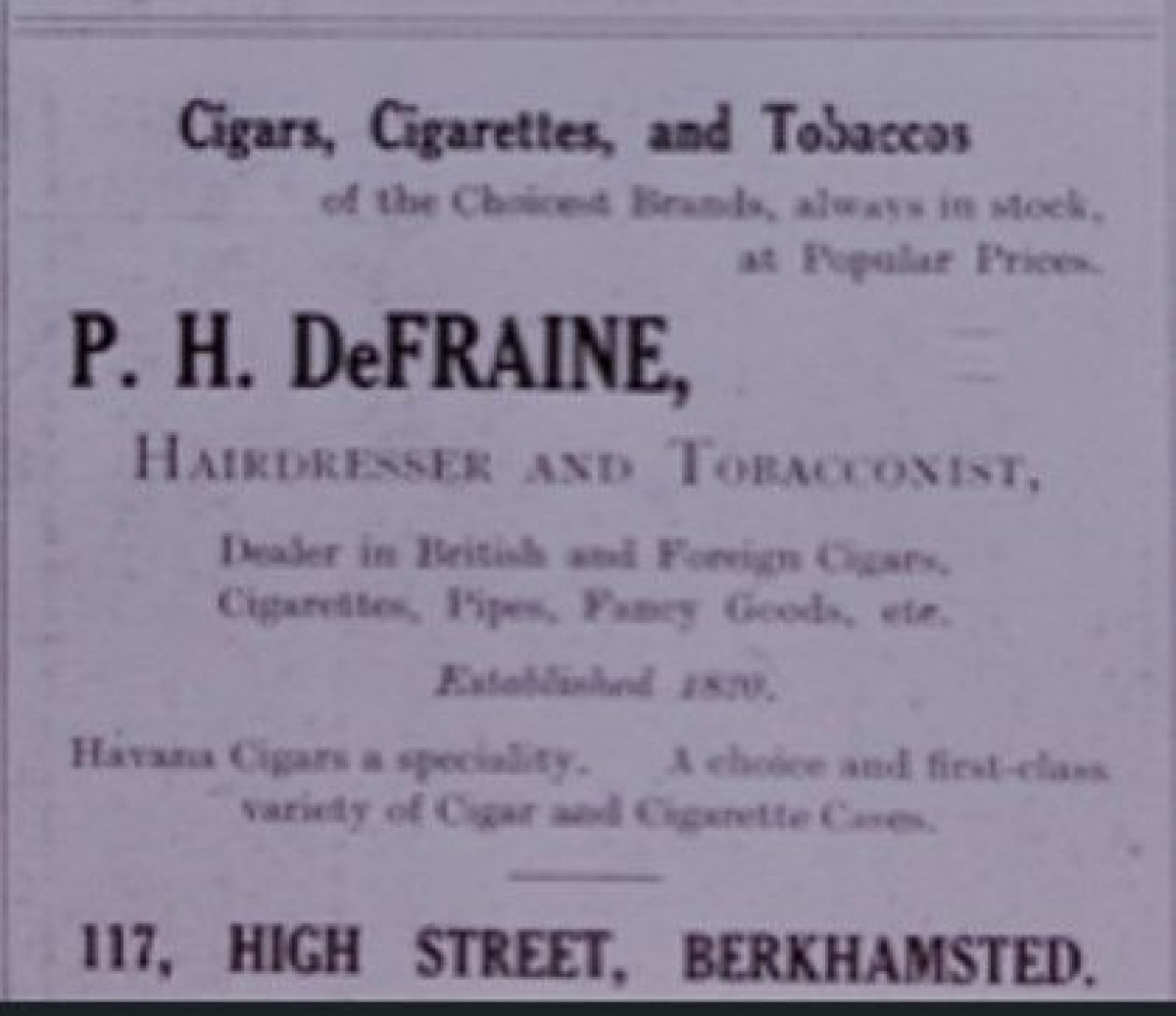
In addition to pursuing his business as a hairdresser, Philip also expanded his business, branching out as a tobacconist. He described his occupation on the 1911 census as “hairdresser and tobacconist.” A newspaper advert, dating from the same year, although mentioning the fact he is a hairdresser, promoted his business as a tobacconist.
Philip was also actively involved in other activities in the town. Newspaper articles from 1909 reveal that he was a member of the cricket club and served on the club’s committee. He was a member of the Friendly Society and made contributions to the Society’s funds. He was a member of the Berkhamsted Dramatic Club, being the stage manager for the club’s 1911 production of “What Would a Gentleman Do?”
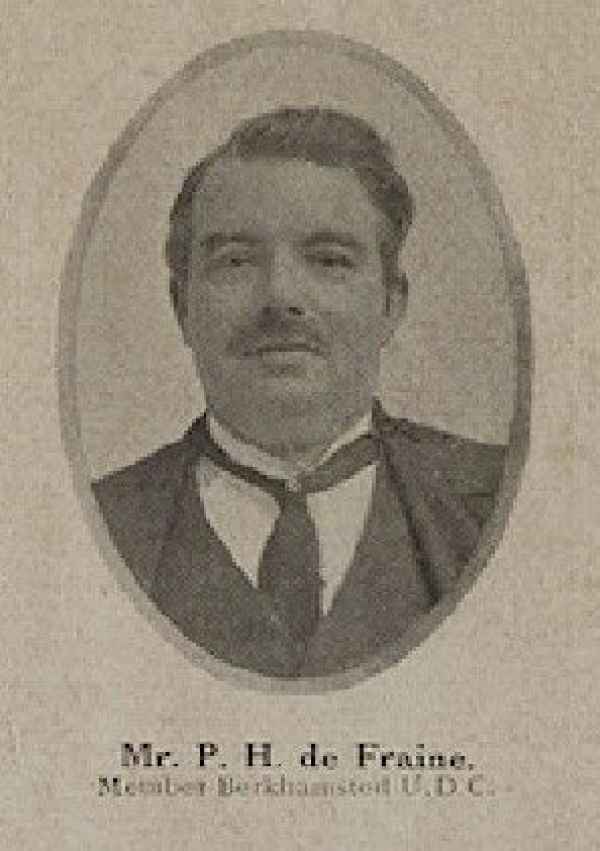
The Berkhamsted Urban District Council came into being in 1898 and Philip was elected as a member, his name appearing on the list of councillors in Kelly’s Directory of 1914. Percy Birtchnell wrote that Philip was not only as “a good hairdresser” but he was also a “spirited councillor.”
As a councillor, Philip campaigned for the construction of a swimming pool in Berkhamsted. It apparently took him some twelve years to persuade the council, but he kept on campaigning and eventually one was built and opened in 1923. Birtchnell recorded that Philip “…had the privilege of declaring it open. He did so by diving into the water having previously thrown a lighted match into the bath to warm it.” The pool used to stand on the Canal Fields near the tennis and football clubs. It was filled during the 1990’s when the new pool was built at Lagley Meadows.
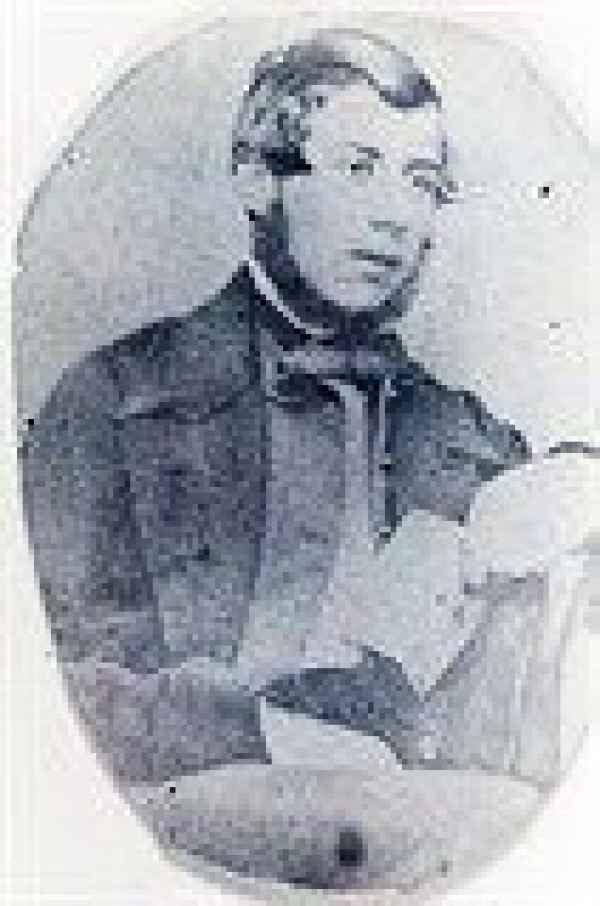
The photograph we have of Philip and Sarah dates from around 1895 and was apparently taken at a wedding of a member of Sarah’s family. As Philip is stood towards the rear, we can only clearly see his face and shoulders, but he appears as a dapper young man. As he grew older he evidently lost his trim figure, as Birtchnell tells us he was both “…very popular (and rotund)…”
Philip died at the age of 66 on the 1st February 1928. His estate was worth £3,476. 19s 7d.
According to Birtchnell, Philip’s death did not see the immediate end of the De Fraine hairdressing business. “…for a short time (in the late 1920’s I think) ‘Daffy’s’ son carried on a business, adding a ladies’ department…”
Daisy de Fraine
Relatives
Research:
- Christopher Dolton
DAISY DE FRAINE; 1886 – 1886
Daisy Alice De Fraine was the first child born to Philip de Fraine and his wife Sarah (nee Keys) . Philip and Sarah had married in June 1885 and Sarah was born during the second quarter of the following year, 1886. Sarah and her family were from Marylebone, London, and Philip may have ben working as a printer in Leighton Grove where the Keys family lived. Daisy herself was born in London, her birth being registered in Fulham.
Sadly, Daisy did not live long, she died shortly after her birth, the death being registered during the third quarter of 1886. That she died so young, was not unusual at the time. Infant and child mortality was very high during the Victorian era. High mortality rates among the young were the result of industrialisation, which led to rapid urbanisation, increased pollution, severe impoverishment, and exploitation of child labour. According to Report of the Medical Officer of Health for the City of London in 1849, the death rate for children under 5 years of age was around 33% in some areas in London. The infant mortality rate for Berkhamsted was little better, although it was recognised that mortality rates were worse in the towns and cities than in rural areas. In 1851 the rate stood 151.38 deaths per 1000 in Berkhamsted, dropping steadily over the years to 87.39 per thousand in 1911.
The first ten years of the twentieth century saw a number of investigations and publications on the subject of infant mortality. The first National Conference on Infant Mortality was held in 1906 followed by the second two years later. This activity was motivated by a growing conviction that a large proportion of the wastage of infant life was preventable. Happily, today the infant mortality rate is much reduced. The rate for the Borough of Dacorum, of which Berkhamsted is today a part, was 3.16 per thousand in the years 2016/2018.
Phillip de Fraine
Relatives
Research:
- Melanie Hilton
Plot x124 Phillip de Fraine (Born & died 1891)
Phillip was the son of Philip and Sarah Jane de Fraine. Sadly he only lived a few months. He is buried here with his father.

Do you know these people?
If you have any memories, family history or photographs that could help us to build up more information about these burials, please contact us - we would love to hear from you.
If you have any memories, family history or photographs that could help us to build up more information about these burials, please contact us - we would love to hear from you.
Memorial details
| Family name | Fraine |
| Burial date | 06/07/1883 |
| Burial capacity | Not known (Full used) |
| Burial depth | Not known |
| From burial books? | |
| Burial visible (2019)? | |
| Burial visible (1991)? |
Burial book says William Defrain – see 17/191
Condition: good
Photos


Town connections
Discover the historical links to Plot for Smith and de Fraine around Berkhamsted and beyond:
 Berkhamsted Town Hall
In Memoriam
If you have a family or other connection with anyone buried in this plot, you are welcome to post your memories or photographs here.
 Personalities of the Past
 Memorial Symbolism

 Military graves